Jenny Saville: Life, Record Auction & Famous Paintings
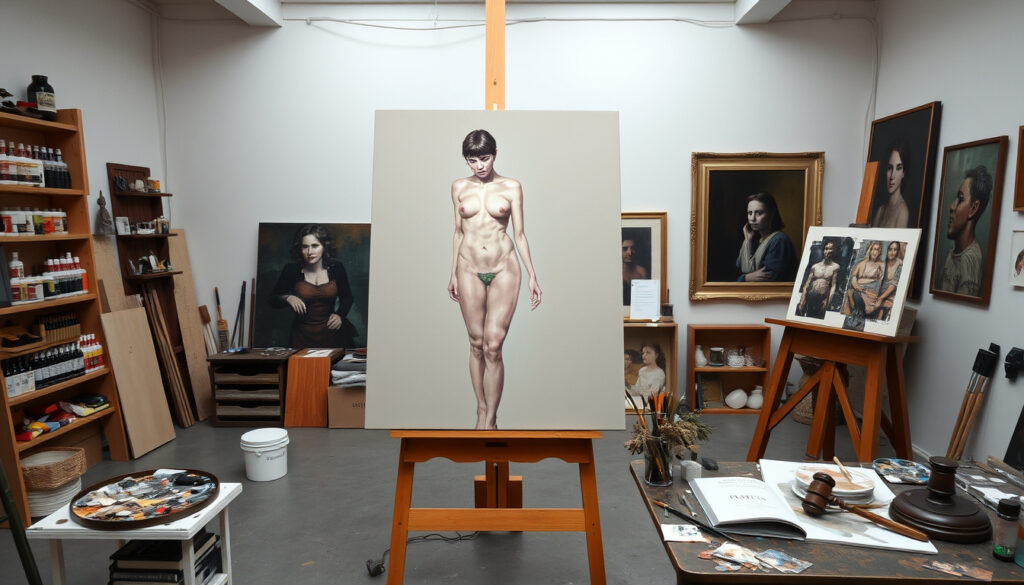
Jenny Saville’s oversized canvases make a gallery wall feel like a crowded room, with fleshy, monumental figures that have made her one of the most talked-about artists of her generation. Grouped with the Young British Artists of the 1990s, her work carries a quieter, more painterly weight that has followed her from studio to auction block, where her canvases now command eight-figure sums.
Born: 7 May 1970 (age 55) · Education: Glasgow School of Art (1988–1992) · Movement: Young British Artists · Gallery: Gagosian Gallery · Record Auction: $12.4 million for Propped (2019)
Key Facts at a Glance
- Born Jennifer Anne Saville on 7 May 1970 in Cambridge, England, per the National Galleries of Scotland (public art collection).
- Studied at Glasgow School of Art from 1988 to 1992, where she began developing her signature approach to the human figure, as noted by the National Galleries of Scotland.
- Her breakthrough came in 1994 when collector Charles Saatchi purchased a significant body of her early work after seeing her graduate exhibition, according to the National Galleries of Scotland.
- An original member of the Young British Artists, though her methods are firmly rooted in classical painting traditions, as stated by the National Galleries of Scotland.
- Often works on a monumental scale, using thick paint, layered glazes, and photographic references to build her figures, per the Tate (national museum of British art).
- Her work is frequently described as combining the physicality of Francis Bacon with the draftsmanship of Old Masters like Rubens, as referenced by Artnet (international art market news platform).
- In October 2018, Propped (2000) sold for $12.43 million at Sotheby’s London, a record for the artist, documented by Heni (arts publication and auction analysis platform).
- That result marked a significant jump from her previous auction high of $9.5 million, achieved just months earlier in June 2018, per the same Heni report.
- Her auction history includes notable sales at Christie’s and Sotheby’s spanning more than a decade, as recorded by Heni.
- Represented by Gagosian Gallery, one of the world’s most powerful commercial galleries, as listed on Gagosian (international commercial gallery).
- Her work has been featured in major institutional exhibitions, including a 2022 retrospective at the Fitzwilliam Museum in Cambridge, as covered by the Fitzwilliam Museum (public museum).
- Saville’s canvases are included in leading public collections, from the Tate to the Museum of Fine Arts, Boston, per the Tate (national museum of British art).
Who Is Jenny Saville and Why Does Her Work Matter?
Jenny Saville is a contemporary English painter known for confronting the viewer with unidealized, monumental views of the human body. According to the National Galleries of Scotland (public art collection), she is recognized as one of the leading figures in contemporary art, and her approach helped spark a broader revival in figural painting. Unlike many of her peers who embraced conceptual or multimedia practice, Saville committed early on to oil paint and the human form, a choice that now feels prescient given the market’s renewed appetite for painterly skill.
Her work often grows from photographs of real people, including her own body and those of friends, which she enlarges and transforms with her brush. The resulting images are neither flattering nor documentary; they are explorations of flesh, pressure, and the boundary where a body ends and a surface begins. As Sotheby’s (international auction house) notes, she is celebrated as one of the leading contemporary artists whose work has been pivotal in bringing figuration back to the center of serious art discourse.
Why Is Jenny Saville So Famous?
Saville’s fame rests on her ability to merge classical painting traditions with a confrontational, unflinching approach to the female body. She gained international recognition as a leading figure in the Young British Artists movement, and her painting Propped set a record price for a living female artist at auction. Her large-scale oil paintings explore flesh, weight, and volume in ways that challenge traditional representations of the body, making her a standout figure in contemporary art.
What Makes Her Paintings Unique?
Her paintings are distinctive for their monumental scale, thick impasto, and layered glazes that build figures from photographic references. Rather than idealizing the body, she presents it as heavy, scarred, and awkward — a raw depiction that separates her from a long tradition of idealized figuration. The physicality of the paint itself becomes a metaphor for the flesh she depicts.
How Did She Become Part of the Young British Artists?
She emerged alongside Damien Hirst, Tracey Emin, and others associated with the Young British Artists. Her inclusion in Charles Saatchi’s landmark 1997 exhibition Sensation introduced her to a global audience. Despite the association, her practice is closer to the studio traditions of Lucian Freud than to the conceptual shock tactics of her peers.
The Young British Artists Connection
- She emerged alongside Damien Hirst, Tracey Emin, and others associated with the Young British Artists.
- Her inclusion in Charles Saatchi’s landmark 1997 exhibition Sensation introduced her to a global audience.
- Despite the association, her practice is closer to the studio traditions of Lucian Freud than to the conceptual shock tactics of her peers.
The Tate (national museum of British art) describes her work as “often monumental in scale” and notes that she “confronts our conventional ideas of beauty.” That tension between beauty and unease is at the heart of her appeal. She uses paint to exaggerate, blur, and sometimes nearly dissolve the subject, so that a canvas becomes less a picture of a person and more an argument about what it means to occupy a body.
“My work is about the physical body, not the ideal body.”
— Jenny Saville, quoted by Artnet (international art market news platform)
Saville’s long-standing commitment to figurative oil painting — at a time when many dismissed it as outdated — positioned her as a bridge between the conceptual art world and traditional craft, and that duality is a big part of why her works are so sought after today.
Where Did Jenny Saville’s Auction Record Come From?
Saville’s auction history tells a story of steady growth followed by a dramatic leap in the space of a few months. The key event came in 2018, when her painting Propped — a large charcoal-and-oil work from 2000, featuring a small figure leaning over a table — was offered at Sotheby’s London. According to Heni (arts publication and auction analysis platform), the work sold for $12.43 million (£9.54 million) on 5 October 2018, setting a new record for any work by the artist.
What makes that result even more notable is that it came just months after her previous record was set. Heni also reports that in June 2018, Propped (a different work from the same series) sold for £9.5 million at Sotheby’s London, which at the time was a personal best for the artist. The rapid succession of two record prices within one year signaled that the market’s assessment of Saville had shifted decisively, moving her from the top tier of contemporary painters into a rarefied group where prices are closer to those of established blue-chip modernists.
How Much Do Jenny Saville Paintings Sell For?
Secondary market prices vary widely, from tens of thousands to millions depending on size, period, and provenance. Her auction record of $12.4 million for Propped places her among the highest-valued living female artists. Her primary market prices, set through Gagosian Gallery, remain private but reflect strong institutional demand and limited supply.
What Is the Auction Record for a Jenny Saville Painting?
| Work | Price | Venue & Date | Category |
|---|---|---|---|
| Propped | $12.43 million (£9.54 million) | Sotheby’s London, 5 October 2018 | Auction record |
| Propped (alternative version) | £9.5 million | Sotheby’s London, June 2018 | Previous record |
| Branded | $425,600 | Christie’s London, 27 June 2001 | Early market sale |
| Interfacing | $175,000 | Christie’s New York, 17 May 2001 | Early market sale |
| Rosetta 2 | $1.1 million | Sotheby’s London, 17 October 2008 | Mid-career sale |
| Figure 1123 | $918,300 | Christie’s London, 6 February 2008 | Mid-career sale |
Heni’s documentation also records that Rosetta 2 sold for $1.1 million at Sotheby’s London on 17 October 2008, and that Figure 1123 changed hands for $918,300 at Christie’s London on 6 February of the same year. Earlier in the decade, Branded fetched $425,600 at Christie’s London on 27 June 2001, and Interfacing sold for $175,000 at Christie’s New York on 17 May 2001. Those figures, drawn from the same Heni (arts publication and auction analysis platform) report, show that her market did not spike overnight — it matured over nearly two decades before the 2018 surge.
What Factors Influence the Value of Her Work?
Her slow production rate — she paints relatively few canvases each year — creates scarcity that drives demand. Institutional representation, critical acclaim, and major museum holdings further underpin prices. The 2018 record reflects both the quality of her output and a broader market shift toward contemporary figurative painting.
The gap between her 2001 sales and her 2018 records isn’t just inflation — it reflects a fundamental revaluation of contemporary figuration. Buyers who once reserved eight-figure sums for iconic male artists now see Saville’s work as a rare combination of technical mastery, historical resonance, and cultural significance.
What Quotations Reveal About Saville’s Artistic Philosophy?
The way Saville talks about her own work is unusually revealing. In an interview with Artnet (international art market news platform), she explained a core motivation: “My work is about the physical body, not the ideal body.” That single sentence separates her from a long tradition of artists who used the figure as a vehicle for idealized beauty. For Saville, the body is a fact — heavy, changing, scarred, and awkward — and her job is to translate that truth onto canvas with as much honesty as possible.
“My work is about the physical body, not the ideal body.”
— Jenny Saville, quoted by Artnet (international art market news platform)
She has also spoken directly about why she is drawn to flesh as a subject. Artnet additionally reports her remark that flesh is “just the most beautiful thing to paint.” Coming from an artist who has spent decades depicting bodies in states of pressure, weight, and intimacy, that claim carries more weight than a casual aesthetic preference. It suggests that her choice of subject and her painterly technique are inseparable — the fleshiness of the paint itself becomes a metaphor for the flesh she depicts.
“Flesh is just the most beautiful thing to paint.”
— Jenny Saville, quoted by Artnet (international art market news platform)
What Are Some of Jenny Saville’s Most Famous Quotes?
Beyond her remarks on the physical body and flesh, Saville has offered other revealing statements about her practice. In a Tate talk she described wanting to “make the skin real, the flesh real, the body real,” a phrase that captures her material approach. She has also stated, “I paint flesh because I’m human,” as quoted by Artnet, underscoring the personal stakes in her figuration. These quotes, taken together, frame the core tension in her work: a commitment to unidealized reality paired with a profound reverence for the visual possibilities of the human body.
How Has Saville’s Career Evolved Beyond the Studio?
Saville’s influence extends well beyond auction results. She has been the subject of major institutional retrospectives, and her works are held in important public collections across the world. In 2022, the Fitzwilliam Museum in Cambridge mounted a significant exhibition of her work, bringing her large-scale paintings into dialogue with Old Master drawings and paintings from the museum’s own collection. That curatorial pairing is telling: it positions Saville not merely as a contemporary celebrity, but as a participant in the ongoing history of painting.
Her gallery representation has also played a role in shaping her public profile. As one of the leading artists represented by Gagosian (international commercial gallery), she has had access to top-tier exhibition platforms and collectors worldwide. Yet unlike some artists whose careers are built on constant output, Saville is known for working slowly and producing relatively few paintings. That scarcity, combined with high demand, has become a defining feature of her market.
For readers interested in other iconic British artists, see our guide on Artist Banksy: Real Identity, Famous Works, and Worth.
With her record now firmly in the eight-figure range, the next question is whether her earlier works — especially the monumental canvases from the mid-1990s — will follow the same trajectory. Her slow production rate means supply is tight, which historically has been a strong driver for sustained price growth.
Has Jenny Saville Won Any Major Awards?
Unlike some of her contemporaries, Saville’s recognition has come primarily through institutional exhibition and market success rather than a crowded shelf of competitive prizes. She was, however, elected a Royal Academician in 2005, an honor that places her within a distinguished lineage of British artists. That distinction, noted by The Royal Academy of Arts (British art institution), reflects the high regard in which she is held by her peers in the British art establishment.
Her visibility was further boosted by her inclusion in the landmark 1997 Sensation exhibition at the Royal Academy, which toured internationally and became one of the most publicly debated art shows of the decade. While the exhibition was controversial for its conceptual works, Saville’s paintings stood out for their formal rigor. That combination of institutional approval and public controversy built the foundation for her later market success.
Summary
Jenny Saville’s record price of $12.43 million at Sotheby’s London in 2018 is not an outlier — it is the culmination of three decades of consistent, uncompromising work that has gradually shifted how critics and collectors understand contemporary figuration. Her market has risen alongside a broader revaluation of painterly skill and the human figure, which suggests that her canvases may continue to set benchmarks for living female artists. If her production remains measured and her institutional presence continues to grow, the next chapter of her career may well be defined by the question of which of her early masterpieces will be the first to cross the $15 million mark.
Related reading: Artist Banksy: Real Identity, Famous Works, and Worth · Tim Berners-Lee: Inventor of the World Wide Web – Life and Legacy
en.wikipedia.org, artsy.net, mutualart.com, blog.naver.com, artdaily.cc, liveauctioneers.com, antiquesandthearts.com
Frequently asked questions
How does Jenny Saville’s work compare to other YBA artists?
Unlike peers such as Damien Hirst or Tracey Emin, who often embraced conceptual strategies, shock tactics, or personal narrative, Saville remained committed to figurative oil painting and classical draftsmanship. Her works share the YBA era’s directness and ambition but are grounded in painting techniques that align more closely with artists like Lucian Freud or Francis Bacon.
Has Jenny Saville won any major awards?
Saville’s recognition has come primarily through institutional exhibitions and market success rather than a long list of competitive prizes. She was elected a Royal Academician in 2005, an honor that places her within a distinguished lineage of British artists, and her inclusion in the 1997 Sensation exhibition brought her international attention.
What is Jenny Saville’s most famous painting?
Propped (2000) is widely considered her most famous and commercially significant work, having set the artist’s auction record at $12.43 million at Sotheby’s London in 2018. The painting features a small figure leaning over a table, executed in her characteristically layered, flesh-toned palette.
Where can I see Jenny Saville’s work in person?
Her works are held in major public collections including the Tate in London, the National Galleries of Scotland, and the Museum of Fine Arts, Boston. She has also been the subject of major retrospectives, such as the 2022 exhibition at the Fitzwilliam Museum in Cambridge, which paired her paintings with Old Master works.
What is Jenny Saville’s relationship with the Young British Artists?
Saville is considered an original member of the Young British Artists, having emerged alongside figures like Damien Hirst and Tracey Emin in the late 1980s and 1990s. While she shares the group’s ambition and willingness to challenge conventions, her chosen medium is traditional oil painting, which distinguishes her practice within the group.
Why do Jenny Saville’s paintings sell for so much money?
The combination of critical acclaim, institutional representation, and market scarcity drives her prices. She produces relatively few works, and her canvases address a deeply resonant subject — the human body — with an unmatched painterly skill. The 2018 record for Propped at $12.43 million reflects both the quality of her output and a broader market shift toward contemporary figurative painting.
More related posts
 How to Turn Off iPhone: Settings, Buttons & Force Restart
 Ayra Starr: Relationship Status, Net Worth, and Facts
 Sam Campbell: Barry Award, Taskmaster & Health Speculation
 Richard Briers: life, career and emphysema death
 Goodwood Festival of Speed 2026: Location, Tickets, Dress Code
 Raquel Welch Cause of Death: Cardiac Arrest & Alzheimer’s
 Washing Up Liquid Environmental Impact: Is It Harmful