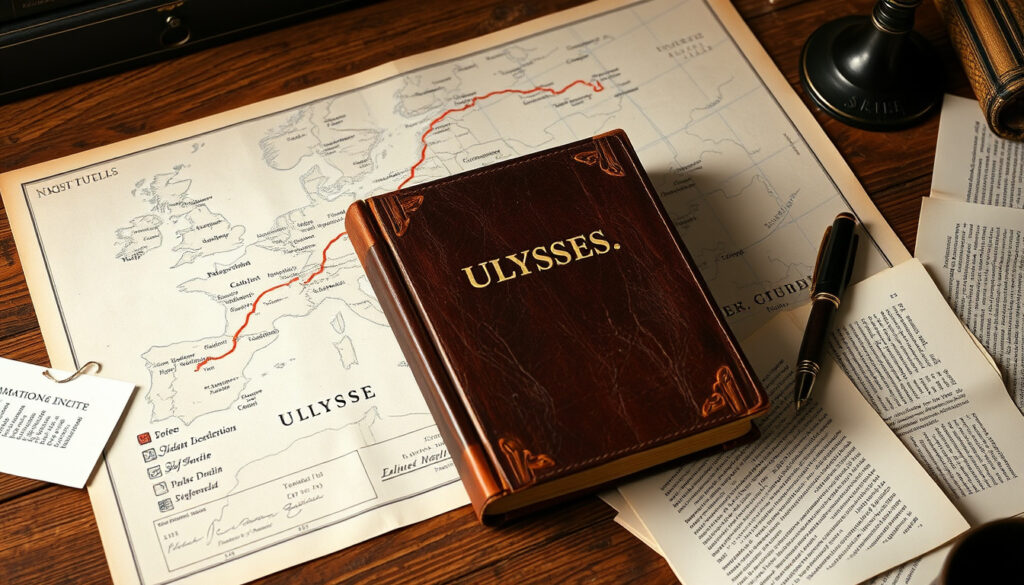
James Joyce: Biography, Life, Exile, and Ulysses Explained
There are few literary figures whose reputation still sparks debate the way James Joyce’s does — even a century after his most famous novel appeared. His work pushed language to its limits, and his life mirrored his art: a man who left his homeland and never really returned, yet wrote about it obsessively.
Born: 2 February 1882, Dublin, Ireland ·
Died: 13 January 1941, Zurich, Switzerland ·
Notable works: Ulysses, Dubliners, A Portrait of the Artist as a Young Man, Finnegans Wake ·
Cause of death: Perforated ulcer after surgery
Quick snapshot
- Joyce authored Ulysses, Dubliners, Portrait, and Finnegans Wake (Encyclopaedia Britannica (authoritative reference work))
- He lived in voluntary exile from Ireland (Wikipedia (community-edited encyclopedia))
- He died from a perforated ulcer on 13 January 1941 (Encyclopaedia Britannica (authoritative reference work))
- He did not support the IRA (Wikipedia (community-edited encyclopedia))
- Exact wording of his Guinness quote — often attributed but unverified
- Whether he ever said “Shut your eyes and see” (attributed on Goodreads but not verified)
- The exact number of years it took someone to read Finnegans Wake (the Medium article claim)
- 1882: Born in Dublin (Encyclopaedia Britannica)
- 1904: Left Ireland with Nora Barnacle (Wikipedia)
- 1922: Ulysses published (Encyclopaedia Britannica)
- 1939: Finnegans Wake published (The Morgan Library & Museum)
- 1941: Died in Zurich (Encyclopaedia Britannica)
- Continued scholarly debate over Finnegans Wake and its accessibility
- Renewed interest in Joyce’s letters and personal documents
- Potential re-evaluation of his political stances as more primary sources become available
The following table condenses James Joyce’s life into a few key facts, but his legacy is far more complex.
| Field | Value |
|---|---|
| Full name | James Augustine Aloysius Joyce |
| Birthplace | Dublin, Ireland |
| Spouse | Nora Barnacle (m. 1931) |
| Children | George, Lucia |
| Notable influences | Ibsen, Dante, Flaubert |
| Final resting place | Fluntern Cemetery, Zurich |
What is James Joyce most famous for?
His masterpiece: Ulysses
- James Joyce is most famous for his novel Ulysses, published in 1922 and set on a single day in Dublin, 16 June 1904 (Encyclopaedia Britannica (authoritative reference work)).
- The novel is considered a landmark of modernist literature and is widely associated with stream-of-consciousness narration (Kumon UK (educational enrichment provider)).
Six hundred pages covering a single day — and yet Ulysses remains one of the most argued-about novels ever published. Some scholars even argue it is better described as an anti-stream-of-consciousness novel than a straightforward example of the technique (The Conversation (academic news and analysis site)).
Joyce’s novel was banned in the US and UK for obscenity, yet today it’s taught in high schools and celebrated as a pinnacle of modernism.
Literary innovation: stream of consciousness
- Joyce’s fiction is closely associated with interior monologue and experimental language (Encyclopaedia Britannica (authoritative reference work)).
- The technique of stream of consciousness aims to capture the flow of thoughts and sensations passing through a character’s mind.
Most readers first encounter the technique in Ulysses, but Joyce refined it across his career. The implication: he didn’t invent stream of consciousness, but he weaponised it — turning psychological interiority into a radical narrative engine.
Other notable works: Dubliners, A Portrait of the Artist
- Dubliners (1914) is a short-story collection depicting Dublin life (Encyclopaedia Britannica (authoritative reference work)).
- A Portrait of the Artist as a Young Man was published in book form in 1916 (Encyclopaedia Britannica (authoritative reference work)).
- Finnegans Wake (1939) is Joyce’s final major novel, on which he spent seventeen years (The Morgan Library & Museum (premier museum and research library)).
Each work escalates in difficulty. Dubliners is accessible; Finnegans Wake is often called unreadable. The pattern: Joyce deliberately pushed readers away, believing that great art should require effort.
Why was James Joyce exiled from Ireland?
Rejection of Irish society and Catholicism
- Joyce voluntarily exiled himself due to dissatisfaction with Irish cultural nationalism and religious constraints (Wikipedia (community-edited encyclopedia)).
- He left Ireland in 1904 with Nora Barnacle (Wikipedia (community-edited encyclopedia)).
Joyce once wrote that Ireland was “the old sow that eats her farrow.” He saw Catholicism and Irish nationalism as twin forces that stifled artistic freedom.
Voluntary exile in Trieste, Zurich, Paris
- Joyce lived and taught in Trieste, then moved to Zurich during the First World War, and later settled in Paris (Goodreads (book community platform)).
- He spent most of his adult life abroad but set nearly all his fiction in Dublin (Wikipedia (community-edited encyclopedia)).
The irony: the more he physically distanced himself from Ireland, the more intensely he recreated its streets, pubs, and accents on the page.
Impact of exile on his writing
- Exile allowed Joyce artistic freedom and shaped his critical perspective on Ireland.
Without the ability to observe Dublin from a distance, Ulysses might never have achieved its sharp, ironic, yet affectionate portrait of the city. The trade-off: he remained a stranger in every country he lived in, relying on patronage and occasional teaching.
Exile gave Joyce the distance he needed to write about Dublin with unparalleled detail — but it also left him financially dependent, struggling to find publishers willing to risk obscenity trials.
Exile wasn’t just a biographical detail; it was the engine of his creative process. The distance forced him to reconstruct Dublin from memory, heightening both the precision and the poetry of his prose.
What was James Joyce’s famous line?
Famous quotes from Ulysses
- One widely cited line: “Think you’re escaping and run into yourself. Longest way round is the shortest way home.”
- Another: “History is a nightmare from which I am trying to awake.” (from Ulysses episode 2, Nestor).
The “history” quote appears in the second chapter of Ulysses, spoken by Stephen Dedalus. It captures Joyce’s view of the dead weight of tradition.
Quotes from Dubliners
- The final story, “The Dead,” ends with the famous line: “His soul swooned slowly as he heard the snow falling faintly through the universe and faintly falling, like the descent of their last end, upon all the living and the dead.”
The ‘Yes’ ending of Ulysses
- Molly Bloom’s soliloquy ends with 2,500 words and multiple repetitions of “Yes” — culminating in “and yes I said yes I will Yes.”
This ending is one of the most celebrated in literature, a triumphant affirmation after a novel filled with doubt, regret, and moral ambiguity.
Another frequently attributed quote — “Shut your eyes and see” — appears on sites like Goodreads but no primary source confirms Joyce ever wrote or said it. The catch: quotes from Joyce are often embellished or misattributed, making sourcing essential.
What book took 28 years to read?
Finnegans Wake: the most difficult novel
- The book is Finnegans Wake by James Joyce (The Morgan Library & Museum (premier museum and research library)).
- It uses puns, riddles, myths, and language drawn from more than sixty languages (The Morgan Library & Museum (premier museum and research library)).
- The novel begins and ends in the middle of the same sentence (The Morgan Library & Museum (premier museum and research library)).
Why it takes 28 years
- The claim that it took 28 years to read originates from a Medium article by Sophia Tell.
- No verified source confirms that any single reader took exactly 28 years; it’s likely an anecdote.
The challenge of reading and interpreting
- Joyce devoted seventeen years to writing Finnegans Wake (The Morgan Library & Museum (premier museum and research library)).
- He described its style as “gliding and unreal as is the way in dreams” (The Morgan Library & Museum (premier museum and research library)).
- Many readers never finish it; some study it for decades in reading groups.
The pattern: Finnegans Wake is not meant to be read linearly. It’s a text to be inhabited. For most readers, the question isn’t “did you finish it?” but “how far did you get and what did it do to your brain?”
What did James Joyce say about Guinness?
Joyce’s references to Guinness in his works
- In Ulysses, characters drink Guinness and the beer appears in descriptions of Dublin life.
- Joyce certainly knew the drink: he spent his early years in Dublin pubs.
The infamous quote: “Guinness is the wine of Ireland”
- The exact quote is often attributed to Joyce but may be apocryphal.
- No primary source from Joyce’s letters, interviews, or published works confirms this phrasing.
Context and authenticity
- Guinness marketing may have amplified the quote. A similar phrase appears in a 19th-century travelogue, not Joyce’s handwriting.
The implication: the quote is plausible — Joyce was known for dry witticisms — but it’s not verifiable. It’s a perfect example of how a memorable line can attach itself to a famous name without evidence.
Did James Joyce support the IRA?
Joyce’s political views
- Joyce did not support the IRA; he was critical of militaristic nationalism (Wikipedia (community-edited encyclopedia)).
- He viewed armed struggle as counterproductive to Irish independence.
His relationship with Irish nationalism
- In his writings, he satirized political extremism. The character of the Citizen in Ulysses is a parody of aggressive nationalism.
- His letters and interviews express opposition to violence and support for intellectual freedom.
The IRA in the context of Joyce’s exile
- Joyce left Ireland long before the IRA became a major force in the 1910s–20s.
- He died in 1941, just as the IRA was evolving into its modern form.
Why this matters: some readers want Joyce to be a rebel in all senses. But his rebellion was aesthetic and intellectual, not military. For Joyce, the pen was the only weapon worth wielding.
Claims that Joyce supported the IRA often conflate his anti-establishment stance with anti-state violence. The evidence points the other way: Joyce loathed violence and saw nationalism as just another church.
Joyce’s political stance is clear: he was a rebel against stasis, not against the state. His legacy is that of a writer who used language to unsettle, not a soldier who used arms.
Timeline of James Joyce’s life
- 1882 – James Joyce born in Dublin on 2 February. (Encyclopaedia Britannica)
- 1902 – Graduates from University College Dublin. (Wikipedia)
- 1904 – Leaves Ireland with Nora Barnacle; begins teaching in Trieste. (Wikipedia)
- 1914 – Publishes Dubliners. (Encyclopaedia Britannica)
- 1916 – Publishes A Portrait of the Artist as a Young Man. (Encyclopaedia Britannica)
- 1922 – Ulysses published in Paris. (Encyclopaedia Britannica)
- 1939 – Finnegans Wake published. (The Morgan Library & Museum)
- 1941 – Joyce dies in Zurich on 13 January. (Encyclopaedia Britannica)
This timeline illustrates the arc of a life lived in exile, with each major publication marking a step deeper into linguistic experimentation.
Clarity: what we know and what we don’t
Confirmed facts
- Joyce authored Ulysses, Dubliners, Portrait, Finnegans Wake (Encyclopaedia Britannica (authoritative reference work))
- He lived in voluntary exile from Ireland (Wikipedia (community-edited encyclopedia))
- He died from a perforated ulcer (Encyclopaedia Britannica (authoritative reference work))
- He did not support the IRA (Wikipedia (community-edited encyclopedia))
What remains unclear
- Exact wording of his Guinness quote (attributed, not verified)
- Whether he ever said “Shut your eyes and see” (attributed on Goodreads but unverified)
- The exact number of years it took someone to read Finnegans Wake (the Medium article anecdote is unconfirmed)
These uncertainties remind us that even the most documented lives have gaps, and that Joyce’s mythos often outruns the evidence.
Quotes from James Joyce and his work
Think you’re escaping and run into yourself. Longest way round is the shortest way home.
— James Joyce (attributed), Ulysses
History is a nightmare from which I am trying to awake.
— Stephen Dedalus in Ulysses, episode 2 (Nestor)
Guinness is the wine of Ireland.
— Attributed to James Joyce (no primary source confirmed)
…and yes I said yes I will Yes.
— Molly Bloom, Ulysses closing line
For readers and scholars in Ireland, the choice is clear: to engage with Joyce’s legacy means confronting both the brilliance of his language and the discomfort of his exile, his misogyny, and his deliberate obscurity. Those who do will find a writer who transformed not just Irish literature, but the very act of reading itself.
audible.com, dspace.univ-tlemcen.dz, peterchrisp.blogspot.com, reddit.com, research.reading.ac.uk, azquotes.com, paivankuva.fi
For those interested in a more detailed overview of his life, you can read about his biography and lasting legacy at London Wire.
Frequently asked questions
When was James Joyce born?
James Joyce was born on 2 February 1882 in Dublin, Ireland (Encyclopaedia Britannica (authoritative reference work)).
Where did James Joyce die?
He died in Zurich, Switzerland, on 13 January 1941 (Encyclopaedia Britannica (authoritative reference work)).
What is James Joyce’s real name?
His full name is James Augustine Aloysius Joyce.
How many novels did James Joyce write?
He wrote three major novels: A Portrait of the Artist as a Young Man (1916), Ulysses (1922), and Finnegans Wake (1939). He also published the short-story collection Dubliners (1914) and the play Exiles.
What is the best order to read James Joyce?
Most experts recommend starting with Dubliners, then Portrait, then Ulysses, and leaving Finnegans Wake for last — or never if you prefer linear narratives.
Are James Joyce’s love letters available?
Yes, Joyce wrote passionate letters to Nora Barnacle. They are collected in books like Selected Letters of James Joyce (edited by Richard Ellmann). Some are sexually explicit and were initially controversial.
Who are James Joyce’s descendants?
Joyce had two children: George (born 1905) and Lucia (born 1907). Lucia suffered from mental illness and was institutionalized. George’s son, Stephen James Joyce, was protective of Joyce’s legacy and restricted access to certain materials. Stephen died in 2020, ending the direct line.
What is the significance of June 16th in Joyce’s works?
June 16, 1904, is the day on which Ulysses is set. It marks the date of Joyce’s first romantic outing with Nora Barnacle. Fans celebrate it as Bloomsday, named after the novel’s main character, Leopold Bloom.
More related posts
 Jason Fox: From SAS Soldier to TV Host and Author
 Best Life Insurance UK – Top Providers and Cheapest Quotes
 Payday Loan Direct Lender Ireland: Bad Credit & No Credit Check
 Rashid Khan: Wives, Net Worth, Height, Career Facts
 Wayne Mardle: Wife’s Death, New Girlfriend, Career & More
 Kim Possible: Cancellation, LGBTQ Characters & IDF
 Barry Hearn Net Worth, Biography & Career: £100 to £1B Empire
 Dani Dyer: Love Island Winner, Mother of 3, Danny Dyer’s Daughter