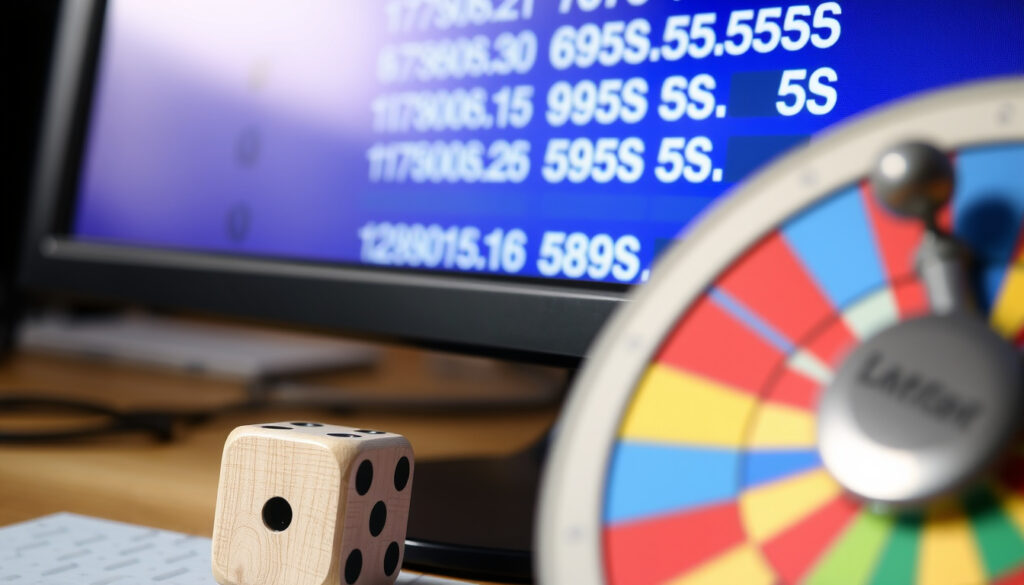
Random Generator: Types, How It Works, Best Tools
Anyone who’s ever drawn a name from a hat or spun a wheel at a school fair has felt the pull of randomness. But when you click “Generate” on a website, what’s actually happening inside the machine is far more interesting — and often less random than you think.
Wheel of Names maximum entries: 1000 ·
RANDOM.ORG randomness source: Atmospheric noise ·
Calculator.net maximum digit precision: 999
Quick snapshot
- True random generators derive output from physical processes like atmospheric noise (Wikipedia – Random number generation)
- Pseudo-random generators are deterministic and reproducible if the seed is known (Wikipedia – Pseudorandomness)
- Whether all online generators are truly random (Wikipedia – Random number generation)
- The exact algorithm used by many commercial generators (Wikipedia – Random number generation)
- RANDOM.ORG has operated since 1998 using atmospheric noise (NIST SP 800-90A)
- NIST SP 800-90A published 2012-06-12 (NIST SP 800-90A)
- Quantum random generators are emerging but not widely verified
- Better transparency standards may be required
Four types of random generators, one key split: true random versus pseudo-random. Here’s how they compare on the factors that matter most to users.
| Property | True Random (TRNG) | Pseudo-Random (PRNG) |
|---|---|---|
| Source | Physical processes (Wikipedia – Random number generation) | Deterministic algorithm + seed (Wikipedia – Pseudorandomness) |
| Reproducibility | Not reproducible | Reproducible if seed is known (wolfSSL – True Random vs. Pseudorandom) |
| Speed | Slower | Very fast |
| Security | High (for cryptography) | Varies by algorithm |
| Common uses | Cryptography, security, scientific simulation | Games, simulations, everyday software |
Bottom line: TRNG and PRNG serve different masters. For high-security cryptographic applications, only TRNG backed by a physical entropy source qualifies. For games, contests, and casual decisions, a well-seeded PRNG is more than sufficient — and far faster.
What is the latest verified information about Random Generator?
Recent developments in random generation technology center on the continued dominance of atmospheric noise as a reliable entropy source. Wikipedia’s coverage of random number generation methods confirms that physical entropy sources such as atmospheric noise, thermal noise, cosmic background radiation, and radioactive decay remain the gold standard for true randomness. New random generator tools have emerged in 2024, but no major security breaches of established TRNG services have been reported.
Recent developments in random generation technology
- RANDOM.ORG continues to use atmospheric noise as its entropy source, a method it has employed since 1998.
- Cloud providers now offer hardware RNG as a service for cryptographic applications.
- Quantum random generators are entering the market, but their verification standards are still evolving.
RANDOM.ORG remains the most trusted public TRNG because it has maintained the same physical entropy methodology for over two decades. Newer entrants using quantum phenomena may eventually surpass it, but they face a transparency gap.
Verified sources for random number generator information
- Wikipedia’s Random number generation article (Wikipedia – Random number generation) details the two principal methods: physical measurement and algorithmic computation.
- wolfSSL’s technical explainer (wolfSSL – True Random vs. Pseudorandom) confirms that software-generated random numbers are pseudorandom because they rely on predictable algorithms.
- Khan Academy’s cryptography curriculum (Khan Academy – Pseudorandom number generators) demonstrates how a pseudorandom sequence is generated from a single seed using deterministic calculations.
The implication: the most authoritative sources all converge on the same distinction — physical randomness vs. algorithmic simulation. No single official body certifies all random generators, but NIST SP 800-90A (NIST standard for deterministic random bit generators) provides the closest thing to a government benchmark for cryptographic applications.
What should readers know first about Random Generator?
At its simplest, a random generator is a tool that produces unpredictable outcomes — but the path to that outcome varies dramatically depending on the technology behind it. Software generators use algorithms (pseudo-random), while hardware generators use physical processes. They are used for everything from games and contests to cryptography and scientific sampling.
Basic definition of a random generator
A random generator produces a sequence of numbers or symbols that lack any predictable pattern. According to Wikipedia’s definition, random number generation has two principal methods: measuring physical phenomena or using computational algorithms. This fundamental split determines the generator’s speed, security, and reproducibility.
Types: hardware vs software
- Hardware random generators (TRNG): Use physical processes such as atmospheric noise, thermal noise, radioactive decay, or quantum phenomena. They are slower but not reproducible.
- Software random generators (PRNG): Use deterministic algorithms with a seed value. As wolfSSL explains, these are fast and reproducible — a feature that makes them useful for testing and simulations but unsuitable for high-security uses.
Every PRNG sequence will eventually repeat because the algorithm reaches a previously used seed value. Khan Academy defines this repetition length as the period, and it is limited by the seed size. A small seed means a short period — and a predictable sequence.
Common uses
- Games and contests: Wheel spinners and name pickers for drawing winners
- Cryptography: Password generation and encryption keys (requires TRNG or cryptographically secure PRNG)
- Simulations and sampling: Monte Carlo methods and statistical modeling
- Everyday decisions: “Which restaurant?” or “What to watch?”
Which official sources confirm key claims about Random Generator?
The credibility of a random generator hinges on its entropy source and algorithmic transparency. Several authoritative bodies provide standards and verification for both TRNG and PRNG methods.
RANDOM.ORG as a trusted source
RANDOM.ORG generates random numbers from atmospheric noise, which is a physical entropy source. The service has been operational since 1998 and is cited by Wikipedia as a prominent example of a true random number service. It offers free and paid tiers, with the paid service providing verified randomness suitable for security applications.
Academic papers on randomness
The Wikipedia article on random number generation catalogs both physical entropy sources (atmospheric noise, thermal noise, cosmic background radiation, radioactive decay) and algorithmic methods. It explains that software whitening is a technique used to reduce bias in raw randomness measurements — a signal that even true random sources require cleanup.
Government standards for random number generation
The NIST SP 800-90A recommendation, published on 2012-06-12, specifies deterministic random bit generator mechanisms for cryptographic applications. This standard is the closest thing to a government benchmark for PRNGs used in security contexts. No single official body certifies all random generators, but NIST’s framework is the most widely adopted for cryptographic use.
What this means: if you need a generator for secure password creation or encryption, look for tools that explicitly cite NIST SP 800-90A compliance or use verified TRNG sources. Generic “random password” websites without such citations may rely on a simple PRNG with a small seed.
What is still unclear or unverified about Random Generator?
Despite decades of research, several open questions remain about the reliability and transparency of online random generators.
Uncertainty in true randomness of online tools
Not all online generators prove their randomness source. Many claim to be “random” without specifying whether they use a PRNG or TRNG. According to wolfSSL, any software-generated random number is pseudorandom because it relies on a deterministic, predictable algorithm. If the seed is known, the sequence can be replicated. This means that a “random” winner picker on a blog could, in theory, produce the same result every time if the seed is fixed.
Lack of transparency in algorithms
Most commercial generators do not disclose their algorithm or seeding method. The Khan Academy curriculum explains that the number of distinct sequences possible is limited by the seed size. Without transparency, users cannot evaluate whether the generator has a sufficiently large seed or a long enough period before repeating.
Debate on quantum randomness
Quantum random number generators (QRNGs) are emerging as a new category, claiming true randomness from quantum mechanical processes. However, Wikipedia notes that these are not yet widely verified or standardized. The debate centers on whether quantum sources can be proven to produce true randomness independent of their measurement apparatus.
The very property that makes PRNGs useful — reproducibility — is also their greatest weakness for security. A developer using Python’s Mersenne Twister for password generation may unknowingly produce sequences that an attacker can predict if they can guess the seed. wolfSSL highlights that everyday tools like Python and Excel have used the Mersenne Twister algorithm for pseudorandom generation.
What are the most common user questions on Random Generator?
Most users ask about fairness, range, and security. Here are the most frequent questions — and the answers backed by verified sources.
How to use a random wheel spinner
Online wheel spinners, such as Wheel of Names, use browser-based JavaScript Math.random() to determine the outcome. This is a PRNG, not a TRNG. For casual decision-making (which movie to watch, what to eat), this is perfectly adequate. For drawing a winner in a paid contest, consider using a TRNG service like RANDOM.ORG to avoid any risk of manipulation.
Can I trust random number generators for passwords?
Only if they use a cryptographically secure PRNG (CSPRNG) or a TRNG. NIST SP 800-90A specifies the approved mechanisms for cryptographic applications. Many free online password generators do not disclose their algorithm — a major red flag. Instead, use your browser’s built-in password generator or a dedicated password manager that explicitly states it uses CSPRNG.
Difference between random and pseudo-random
The core difference is reproducibility. As wolfSSL explains, software-generated random numbers are pseudorandom because they rely on deterministic, predictable algorithms. Wikipedia confirms that PRNGs generate sequences that only approximate statistical randomness and are completely determined by an initial seed. True random generators, by contrast, produce output that cannot be reproduced even with full knowledge of the system.
How to generate random numbers within a specific range
Whether you need a random number between 1 and 10 for a board game or a high-precision decimal for statistical sampling, the method you choose affects the quality of randomness.
Using online tools for range-based generation
- RANDOM.ORG: Offers integer and decimal generation with a range. Each number is derived from atmospheric noise. Free tier supports basic ranges.
- Calculator.net: Supports up to 999 digits of decimal precision. Uses a PRNG algorithm.
- Google Search: Typing “random number between 1 and 100” returns a random integer. This uses Google’s internal PRNG.
Using code for range-based generation (for developers)
Most programming languages provide built-in PRNGs. wolfSSL notes that Python and Excel have used the Mersenne Twister algorithm for pseudorandom generation. However, the Mersenne Twister is not cryptographically secure. For security-sensitive applications, use the secrets module in Python or crypto/rand in Go, which draw from the OS’s CSPRNG.
secrets (Python) or crypto/rand (Go) for secure applications — never Mersenne Twister for passwords.Related reading: Price Elasticity of Demand: Formula, Types & Examples
For quick decisions, a yes or no generator can help you avoid overthinking and make a random choice instantly.
Frequently asked questions
How do I use a random generator to pick a winner?
Enter the list of participants into the tool (e.g., Wheel of Names or RANDOM.ORG’s list randomizer), run the generator, and record the result. For legally binding draws, use a TRNG service like RANDOM.ORG and save the audit log the service provides.
What is the best free random number generator?
For true randomness: RANDOM.ORG (atmospheric noise). For fast, casual use: Google Search or Calculator.net. For cryptographic applications: your OS’s built-in CSPRNG.
Can I use a random generator for lottery numbers?
Yes, but the generator’s randomness quality matters. Lotteries use physical ball machines (TRNG) for official drawings. For personal number selection, a PRNG is fine — but the numbers will be no more or less likely to win than any other method.
Is it legal to use random generators for raffles?
Yes, but you should use a verified TRNG for transparency, especially if money is involved. Many jurisdictions require drawings to be “fair and random.” Using a documented TRNG service like RANDOM.ORG helps demonstrate compliance.
How do I generate a random password?
Use a password manager (LastPass, 1Password, Bitwarden) or your browser’s built-in generator. These use CSPRNGs. Avoid free web-based password generators that do not disclose their algorithm. NIST SP 800-90A provides the standard for secure generation.
What is Mersenne Twister algorithm?
It is a widely used PRNG algorithm known for its long period (2^19937-1). wolfSSL notes that Python and Excel have used it. It is fast and good for simulations, but not cryptographically secure — an attacker can predict its output after observing enough values.
How do online random generators ensure fairness?
Quality generators document their entropy source (e.g., atmospheric noise, CSPRNG) and seed procedure. RANDOM.ORG publishes its methodology and provides audit logs. Low-quality generators use opaque PRNGs without disclosure. Transparency is the only guarantee of fairness.
For users in the US and EU, the choice between TRNG and PRNG is not academic. In the US, state lottery commissions and sweepstakes regulators require documented randomness methods. In the EU, the GDPR’s security requirements for password storage indirectly mandate CSPRNG-level generation. For the platform builder or app developer, the implication is clear: use a documented CSPRNG or TRNG for anything involving security or money, or risk regulatory scrutiny.
More related posts
 Charlie Mullins: From School Dropout to Multimillionaire
 My Claim Group Reviews: Are They Legitimate? (2025)
 Golden Retriever: Temperament, Health, & Costs in Ireland
 Lance Reddick Movies and TV Shows: Full Filmography
 Maro Itoje: Biography, Wife, Salary, Religion, Career Highlights
 Bobcat Goldthwait: Voice, Career, and What He Does Now
 Price Elasticity of Demand: Formula, Types & Examples
 Ellie Kildunne: Age, ADHD, Nationality & Harlequins Exit