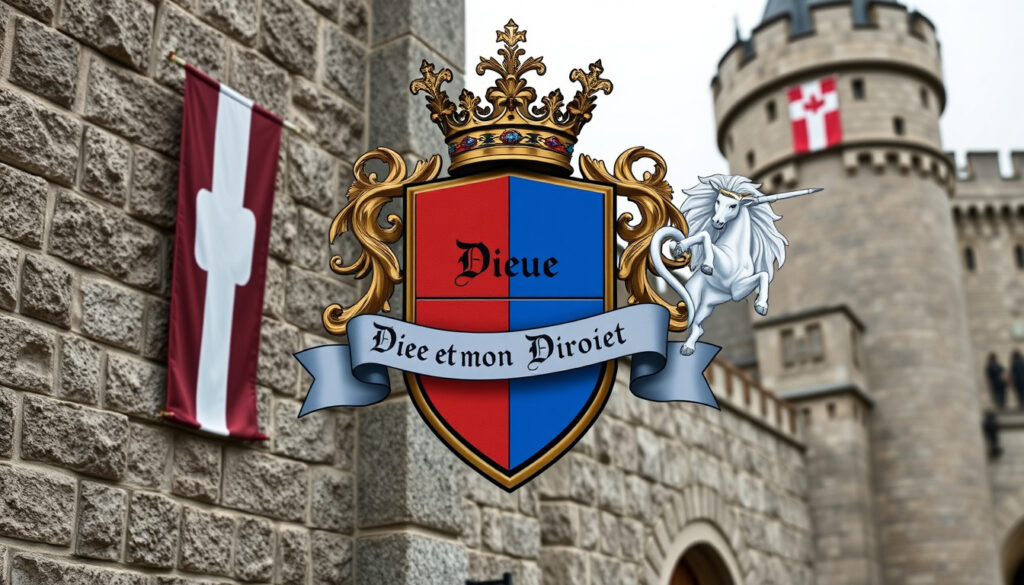
Dieu et Mon Droit Meaning, Origin, and History of the Motto
Few phrases capture the tangled history of England and France quite like the three words etched on the British royal coat of arms: Dieu et mon droit — a motto that has survived centuries of war, revolution, and political change while staying stubbornly in French. By the time you finish this article, you’ll understand how a medieval battle cry became the enduring symbol of a monarchy’s claim to divine right.
First used: 1198 by King Richard I · Official adoption: 1415 by King Henry V · Language: French · Translation: God and my right · Appears on: Royal coat of arms of the United Kingdom
Quick snapshot
- Literal translation from French: “God and my right” (the British Royal Family (official monarchy website))
- Adopted as official royal motto by Henry V in 1415 (Encyclopaedia Britannica (reference publisher))
- Appears on the scroll beneath the shield of the Royal Arms used outside Scotland (the British Royal Family (official monarchy website))
- Exactly when Richard I first used the phrase as a battle cry (Etymonline (etymology dictionary))
- Whether the original wording was exactly “Dieu et mon droit” or an Old French variant like “Deu et mon droit” (Wikipedia (community encyclopedia))
- 1198: Richard I reportedly uses the phrase at the Battle of Gisors (Encyclopaedia Britannica (reference publisher))
- 1340: Edward III places French fleur-de-lis on his coat of arms, incorporating the motto (the British Royal Family (official monarchy website))
- 1415: Henry V officially adopts the motto after Agincourt (Encyclopaedia Britannica (reference publisher))
- Present: Still used on the royal coat of arms and official documents (the British Royal Family (official monarchy website))
- The motto continues to appear on British passports and state documents (UK Government (official guidance))
- Debates about colonial legacy and divine right association persist (Encyclopaedia Britannica (reference publisher))
Five key facts capture the essence of this centuries-old motto.
| Attribute | Value |
|---|---|
| First used | 1198 by King Richard I |
| Official adoption | 1415 by King Henry V |
| Language | French |
| Translation | God and my right |
| Current use | Motto on the royal coat of arms of the United Kingdom |
What does Dieu et mon droit mean?
Literal translation
- The phrase is French for “God and my right” (the British Royal Family (official monarchy website))
- Occasionally rendered as “God and my right hand” in later commentary, though that is not standard (Etymonline (etymology dictionary))
- The Old French version sometimes appears as “Deu et mon droit” (Wikipedia (community encyclopedia))
The literal meaning is straightforward, but the phrase carries a heavier symbolic weight.
Historical interpretation
- The motto is often interpreted as expressing the divine right of kings (Encyclopaedia Britannica (reference publisher))
- It links the monarch’s authority to God rather than solely human institutions (Encyclopaedia Britannica (reference publisher))
The implication: the motto was never just a slogan; it was a constitutional statement about where sovereignty lay.
Connection to divine right
- Medieval kings used the motto to reinforce that their rule came from God (Encyclopaedia Britannica (reference publisher))
- In modern Britain, the phrase remains part of ceremonial identity, not operative constitutional rule (the British Royal Family (official monarchy website))
Why this matters: the gap between historical meaning and modern usage fuels ongoing debate about the monarchy’s role.
A French battle cry meant to assert divine right now serves as a ceremonial emblem in a constitutional monarchy where divine authority no longer governs. The motto outlived the very principle it once proclaimed.
The pattern: understanding this paradox reveals why the motto remains contested today.
Where does Dieu et mon droit come from?
First use by Richard I
- A commonly cited origin story links the phrase to King Richard I at the Battle of Gisors in 1198 (Etymonline (etymology dictionary))
- Some accounts say Richard used it as a battle cry before it became a royal motto (Encyclopaedia Britannica (reference publisher))
- Richard I ruled from 1189 to 1199 (Encyclopaedia Britannica (reference publisher))
The catch: contemporary records of Richard’s exact words are sketchy, so the story remains partly legendary.
Adoption by Henry V
- Henry V formally adopted the motto as the royal motto of England after the Battle of Agincourt (1415) (Encyclopaedia Britannica (reference publisher))
- Henry V reigned from 1413 to 1422 (Encyclopaedia Britannica (reference publisher))
- He used the motto to assert his claim to the French throne (Encyclopaedia Britannica (reference publisher))
The pattern: Henry V turned a battlefield cry into a permanent royal brand, linking military victory with divine favor.
Placement on the royal coat of arms
- The motto has appeared on the British royal coat of arms since Edward III placed French fleur-de-lis on his arms in 1340 (the British Royal Family (official monarchy website))
- It is written on the scroll beneath the shield of the Royal Arms used outside Scotland (the British Royal Family (official monarchy website))
- The Scottish version of the Royal Arms omits the motto (the British Royal Family (official monarchy website))
What this means: the coat of arms tells a story of competing claims—English, French, and Scottish—all wrapped in one visual symbol.
Why is Dieu et mon droit in French?
Norman heritage
- French was the language of the English court after the Norman Conquest (1066) (Encyclopaedia Britannica (reference publisher))
- Court culture in post-Conquest England retained French for centuries in royal and legal contexts (Encyclopaedia Britannica (reference publisher))
The Norman influence explains why a royal motto would naturally be in French, not English.
Claim to the French throne
- Henry V used the French motto to assert his claim to the French crown (Encyclopaedia Britannica (reference publisher))
- Edward III had already placed the French fleur-de-lis on his coat of arms as part of that claim (the British Royal Family (official monarchy website))
The trade-off: the same phrase that claimed French territory also became a permanent reminder of English ambitions across the Channel.
Prestige of the French language
- French was the language of aristocracy and royal display in medieval and early modern England (Encyclopaedia Britannica (reference publisher))
- Using French lent an air of refinement and international prestige (Encyclopaedia Britannica (reference publisher))
Why this matters: the motto’s language choice reflects a period when French was more prestigious than English among the ruling class.
The French motto survived the Hundred Years’ War, the loss of English territories in France, and the rise of English nationalism. It remains because tradition, not linguistic logic, governs royal heraldry.
The implication: language has become a marker of continuity rather than a tool of political claim.
Who said Dieu et mon droit?
Richard I
- Attributed to Richard I as a battle cry at Gisors in 1198 (Encyclopaedia Britannica (reference publisher))
- Whether he actually said it verbatim is uncertain (Etymonline (etymology dictionary))
The legend precedes the documented fact.
Henry V
- Formally adopted the motto as the royal motto after Agincourt (1415) (Encyclopaedia Britannica (reference publisher))
- Henry V’s use made it official and enduring (Encyclopaedia Britannica (reference publisher))
Henry V is the monarch who turned a battle cry into a royal institution.
Later British monarchs
- Every British monarch since Henry V has used the motto (Encyclopaedia Britannica (reference publisher))
- Today it appears on royal documents, passports, and the coat of arms (UK Government (official guidance))
- For more on recent royal figures, see our article on Prince Andrew Royal Perks.
The pattern: the motto has outlasted every monarch who used it, becoming a symbol larger than any individual reign.
What language is Dieu et mon droit?
French
- The phrase is in French (the British Royal Family (official monarchy website))
- It reflects the medieval French that was the court language of Norman England (Encyclopaedia Britannica (reference publisher))
Old French variant
- The Old French version is “Deu et mon droit” (Wikipedia (community encyclopedia))
- Spelling differences reflect the evolution of the French language (Etymonline (etymology dictionary))
What this means: the motto is a linguistic fossil, preserving a form of French that was spoken centuries ago.
Confirmed facts
- Henry V formally adopted the motto after the Battle of Agincourt (Encyclopaedia Britannica (reference publisher))
- The phrase translates to “God and my right” (the British Royal Family (official monarchy website))
- It appears on the present-day British royal coat of arms (the British Royal Family (official monarchy website))
- It is not used on the Scottish version of the Royal Arms (the British Royal Family (official monarchy website))
What’s unclear
- Exactly when Richard I first used the phrase (Etymonline (etymology dictionary))
- Whether the original wording was exactly “Dieu et mon droit” or a variant (Wikipedia (community encyclopedia))
- How the motto was used in official contexts between 1340 and 1415 (the British Royal Family (official monarchy website))
- The precise historical documentation of Richard I’s use is sparse (implied by uncertainty in sources)
The balance of certainty vs. uncertainty shows that while the motto’s modern status is clear, its early history remains a matter of scholarly debate.
Expert perspectives
“Dieu et mon droit is a classic example of how Norman French persisted in royal heraldry long after English became the common tongue. The motto is a linguistic relic of a time when the English court spoke French.”
“The motto has been used by English monarchs and later British monarchs since the reign of Henry V. It is often interpreted as expressing the divine right of kings.”
— Encyclopaedia Britannica (reference publisher)
“Dieu et mon droit: God and my right — motto on the British royal arms.”
The motto Dieu et mon droit began as a medieval battle cry, hardened into a symbol of divine right, and now serves as a ceremonial marker of the British monarchy’s deep roots. For the British monarchy, the choice is clear: embrace the motto as heritage or confront the uncomfortable divine right legacy it carries. The British monarchy continues to balance this tension, as explored in our article on How Did Princess Margaret Die.
monarchies.fandom.com, 15minutehistorypodcast.org, frenchly.us
Frequently asked questions
Is Dieu et mon droit the official motto of the United Kingdom?
Technically, it is the motto of the monarch and appears on the Royal Arms used outside Scotland. It is not an official state motto in the same way some countries have one. (the British Royal Family (official monarchy website))
What does “mon droit” mean in the phrase?
“Mon droit” means “my right” in French, referring to the monarch’s right to rule. (the British Royal Family (official monarchy website))
Does Dieu et mon droit appear on British passports?
Yes, the motto appears on the cover of British passports as part of the royal coat of arms. (UK Government (official guidance))
What is the difference between “Dieu et mon droit” and “Honni soit qui mal y pense”?
“Honni soit qui mal y pense” (Shame on him who thinks evil of it) is the motto of the Order of the Garter. Both are French and appear on the royal coat of arms, but they have different origins and meanings. (the British Royal Family (official monarchy website))
Has the motto ever been changed or removed?
No, the motto has remained unchanged since Henry V adopted it. It appears in the same form on the current Royal Arms. (the British Royal Family (official monarchy website))
What does “Dieu et mon droit” symbolize today?
It symbolizes the continuity of the British monarchy and its historical roots in medieval kingship. Critics see it as an outdated relic of divine right, while supporters view it as a cherished tradition. (the British Royal Family (official monarchy website))
More related posts
 Lucy Beaumont: Disability, Partner, Divorce & Facts
 Barry Bannan Bio: Age, Height, Wife, Net Worth, Career Stats
 BBC News UK Today: Breaking News & Top Headlines | Live Updates
 Dani Dyer: Love Island Winner, Mother of 3, Danny Dyer’s Daughter
 Henry Ford: Biography, Inventions, and Controversial Legacy
 Mary Seacole Biography: Life, Crimean War Nursing, and Legacy
 Hugh Grant: Biography, Children, and Controversies
 Luke Hemsworth: Biography, Height, Net Worth, and Family