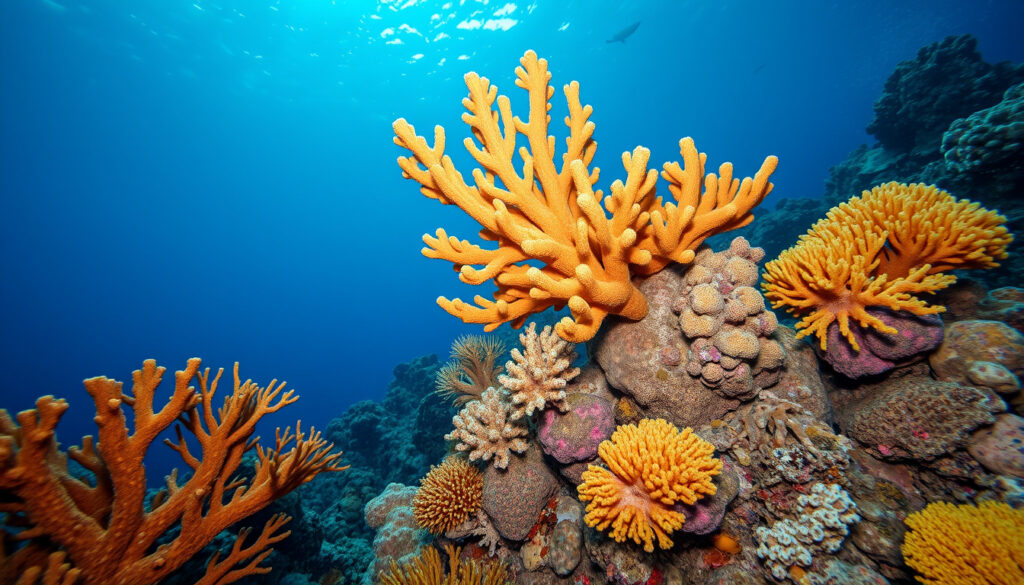
Coral Reef: Types, Threats, and Surprising Facts
Picture an underwater city built not by humans, but by tiny animals. That’s a coral reef — and it’s home to a quarter of all marine life, despite covering less than a tenth of a percent of the ocean floor.
Coral reefs cover less than 0.1% of the ocean floor ·
They support an estimated 25% of all marine species ·
Over 500 million people depend on coral reefs for food, income, and coastal protection ·
The Great Barrier Reef is the largest, spanning over 2,300 km ·
Cold-water coral reefs exist at depths of 200–3,000 meters
Quick snapshot
- Coral reefs are formed by polyps secreting calcium carbonate (Wikipedia)
- Climate change causes widespread coral bleaching (NOAA Ocean Service)
- Irish deep-water coral reefs are changing at a rate of 20% over four years (Marine Institute Ireland)
- Ireland carrying out extensive mapping surveys of offshore reefs (EMFF Marine)
- Conservation and management measures proportionate to fishing pressures will be introduced (EMFF Marine)
Six measures that tell the story of coral reefs at a glance:
| Metric | Value | Implication |
|---|---|---|
| Ocean floor coverage | 0.1% | Disproportionate ecological importance |
| Marine species supported | 25% | Biodiversity hotspot |
| Annual economic value | $375 billion | Global economic driver |
| People dependent on reefs | 500 million | Food and income security |
| Oldest known reefs | 500 million years | Ancient resilience |
| Great Barrier Reef length | 2,300 km | Largest living structure |
What exactly is a coral reef?
A coral reef is an underwater ecosystem built by colonies of coral polyps held together by calcium carbonate. It’s why they’re often called the “rainforests of the sea” — a comparison that holds up: reefs are home to nearly a quarter of all marine species (Wikipedia).
How are coral reefs formed?
- Coral polyps, tiny soft-bodied organisms, settle on submerged surfaces.
- They secrete calcium carbonate skeletons that accumulate over time.
- Generations of polyps build on top of older skeletons, creating the reef structure (NOAA Ocean Service).
What this means: reef-building is slow — millimetres a year for many species — which makes their destruction especially consequential.
What are coral polyps?
- Coral polyps are small, sac-like animals related to jellyfish and sea anemones.
- Each polyp has a mouth surrounded by tentacles that capture plankton.
- Many polyps host symbiotic algae (zooxanthellae) that produce food through photosynthesis (Wikipedia).
Those symbiotic algae are temperature-sensitive. When ocean temperatures rise, the algae are expelled — and the coral starves. That’s coral bleaching.
What is the difference between warm-water and cold-water coral reefs?
- Warm-water reefs: tropical, shallow (0–50 m), depend on sunlight for photosynthesis, dominated by reef-building corals like Acropora.
- Cold-water reefs: temperate to polar, deep (200–3,000 m), no sunlight, no symbiotic algae, built by species like Lophelia pertusa (Wikipedia).
The implication: cold-water reefs are not just deeper versions of tropical ones. They operate on entirely different biological rules — and face different threats.
What are the 4 types of coral reefs?
Four distinct reef morphologies have been documented, each with its own structure and location:
Fringing reefs
- Grow directly from the shore, attached to the coastline.
- Most common type of reef, found in the Red Sea and Caribbean.
- Youngest in geological terms (Wikipedia).
Barrier reefs
- Separated from land by a deeper, wider lagoon.
- The Great Barrier Reef is the most famous example.
- Often older and larger than fringing reefs (Wikipedia).
Atolls
- Ring-shaped reefs that enclose a central lagoon.
- Form when volcanic islands subside, leaving the reef behind.
- Common in the Pacific and Indian Oceans (Wikipedia).
Patch reefs
- Isolated, often circular reefs found within lagoons or between larger reefs.
- Smaller and less continuous than barrier reefs (Wikipedia).
Why this matters: each type has different exposure to climate, human activity, and conservation approaches. A fringing reef near a city faces different pressures than a remote atoll.
What is the biggest killer of coral reefs?
Multiple threats combine to push reefs into decline, but one stands above the rest:
Climate change and ocean warming
- Rising sea temperatures cause coral bleaching — the expulsion of symbiotic algae.
- Prolonged bleaching can kill coral colonies (NOAA Ocean Service).
- Mass bleaching events have become more frequent since the 1980s.
Warm-water reefs can recover from bleaching if temperatures drop quickly. But the window for recovery is shrinking as intervals between heatwaves shorten.
Ocean acidification
- CO₂ absorbed by the ocean lowers pH, reducing carbonate availability.
- This slows the ability of corals to build and maintain calcium carbonate skeletons (NOAA PMEL).
Pollution and overfishing
- Runoff from agriculture introduces nutrients that fuel algal overgrowth.
- Overfishing removes key herbivores that keep algae in check (Wikipedia).
Coral bleaching
- Not a separate threat — it’s the visible symptom of heat stress.
- The 2016 heatwave bleached 91% of the Great Barrier Reef (Nature).
The pattern: climate change is the multiplier. It amplifies every other stressor, from pollution to overfishing, making it the single biggest killer of coral reefs globally.
What are the top 5 biggest reefs?
Five massive structures, one pattern: the biggest reefs are in warm, shallow tropical waters — but the deepest individual reef structures can be cold-water.
| Reef | Length / Area | Location |
|---|---|---|
| Great Barrier Reef | 2,300 km | Australia (Queensland) |
| Mesoamerican Barrier Reef | ~1,000 km | Caribbean (Mexico–Honduras) |
| New Caledonia Barrier Reef | ~1,500 km (contiguous) | Pacific Ocean (New Caledonia) |
| Florida Keys Reef Tract | ~350 km | USA (Florida) |
| Andros Barrier Reef | ~250 km | Bahamas |
The implication: all five are warm-water. Cold-water reefs, despite covering vast areas of the deep sea floor, don’t make this list because they are not contiguous barrier or fringing structures.
Are there any coral reefs in Ireland?
Yes — and they’re nothing like tropical snorkelling spots. Ireland has extensive cold-water coral reefs, mainly deep-sea species like Lophelia pertusa (Wikipedia). These reefs are found along the continental shelf edge, at depths of 200–1,000 meters.
Cold-water coral reefs in Irish waters
- Biogenic reefs built by slow-growing, deep-sea corals.
- Provide complex habitat for fish, molluscs, and crustaceans (NPWS).
- Ireland’s reef habitat is reported as “unfavourable/bad” to the European Commission (NPWS).
Irish deep-water coral reefs changing faster than previously thought
- Recent studies show change at a rate of 20% over four years (Marine Institute Ireland).
- Main pressure: fishing methods that damage the seafloor can cause “permanent loss to keystone communities” (NPWS).
- Additional pressures include gas and oil exploration, deep-sea mining, and nutrient enrichment (NPWS).
For Ireland’s marine managers, the choice is stark: expand protected areas and enforce fishing restrictions below 400 m — or watch these slow-growing ecosystems degrade within a human lifetime.
Why are cold-water reefs important?
- They are biodiversity hotspots in deep, otherwise barren waters.
- They support commercial fish species.
- EU Regulation 2022/1614 established 16,419 km² of closures for protection below 400 m (NPWS).
What this means: cold-water reefs are not a sideshow. They are protected by EU law, but enforcement is a challenge as fishing fleets move deeper.
Quotes and perspectives
“Coral reefs are some of the most diverse ecosystems in the world.”
NOAA Ocean Service
“One of Ireland’s deep water coral reefs is changing at a rate of approximately twenty percent over four years.”
The pattern: tropical and cold-water reefs face different pressures — but both are changing faster than scientists thought possible a decade ago.
npws.ie, youtube.com, orcaireland.org, torontoedition.com, cityguidecanada.org, dlrcoco.ie, tokyostoryline.com
Frequently asked questions
How do coral reefs form?
Coral polyps secrete calcium carbonate skeletons that accumulate over time, building the reef structure. This process is very slow — often only millimetres per year (NOAA Ocean Service).
What is coral bleaching?
When ocean temperatures rise, coral polyps expel the symbiotic algae that live in their tissues, causing the coral to turn white. If heat stress continues, the coral dies (NOAA Ocean Service).
What is the difference between warm-water and cold-water coral reefs?
Warm-water reefs are shallow, tropical, and depend on sunlight. Cold-water reefs are deep (200–3,000 m), do not need sunlight, and are built by different coral species like Lophelia pertusa (Wikipedia).
How long do coral reefs live?
Individual coral colonies can live for centuries, and the reef structures themselves can be millions of years old. The oldest known fossil reefs date back 500 million years (Wikipedia).
Can coral reefs recover from damage?
Yes, if stressors are removed. Recovery takes years to decades for fast-growing species, and longer for slow-growing cold-water corals. Fishing closures have shown effectiveness in preventing further habitat loss (University of Edinburgh Research Explorer).
What is black coral used for?
Black coral is harvested for jewellery and decorative items due to its dark, hard skeleton. Illegal harvesting is a concern in some regions — recovery rates are poorly understood (Wikipedia).
Why are coral reefs important for humans?
They provide food for 500 million people, protect coastlines from storms, support fishing and tourism industries worth $375 billion annually, and are sources of new medicines (Wikipedia).
What is the largest coral reef in the world?
The Great Barrier Reef off Australia’s coast is the largest, stretching over 2,300 km (Wikipedia).
For Ireland’s policymakers and marine conservation teams, the decision is clear: protect deep-water reefs through enforceable closures and monitoring, or accept a 20% loss every four years. The data is in. The choice isn’t.
More related posts
 Silver Ring Guide: Daily Wear, Finger Luck & 925 vs Pure | 2025
 Davy Jones: Musician vs Myth – What’s the Difference
 Jurnee Smollett: Biography, Family, Career, and Latest News
 Lucas Bergvall: Age, Injury, Transfer, Religion & Brother
 M&S Womens – Complete Guide to Sizes, Quality and Deals
 AQA English Language Paper 1: Structure, Grade Boundaries & Guide
 Archie Lyndhurst: Cause of Death, Family, and Career
 Julia Bradbury: Health, Career, Teetotal Lifestyle