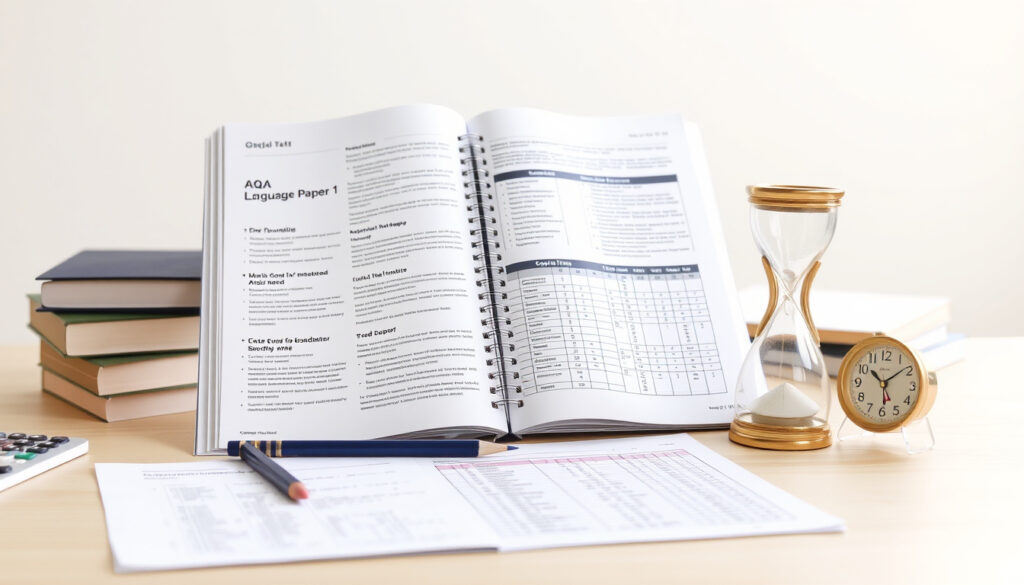
AQA English Language Paper 1: Structure, Grade Boundaries & Guide
If you’re sitting down to revise for AQA English Language Paper 1, you’ve probably already noticed it feels different from other exams — it asks you to write a story as much as it asks you to analyse one, with 80 marks split between reading a fiction extract and crafting your own narrative or description, the test rewards creativity just as much as technique. This guide walks through exactly what’s on the paper, how grade boundaries work, and how AQA compares to other exam boards so you know where you really stand.
Total marks on Paper 1: 80 marks ·
Time allowed: 1 hour 45 minutes ·
Weight of Paper 1 toward GCSE English Language: 50% ·
Grade 9 typical threshold (approx.): 70-75% of total marks ·
Grade 4 typical threshold (approx.): 40-50% of total marks
Quick snapshot
- Section A: Reading (fiction extract, 40 marks) (AQA (exam board specification))
- Section B: Writing (40 marks) (AQA (exam board specification))
- Time: 1 hour 45 minutes (AQA (exam board specification))
- Grade 9 typically 70-75% (BHASVIC (sixth form college grade boundaries data))
- Grade 4 typically 40-50% (BHASVIC (sixth form college grade boundaries data))
- Vary each year (AQA (official grade boundaries guidance))
- AQA vs Edexcel vs OCR (SaveMyExams (revision resource platform))
- No ‘easier’ board; different styles (SaveMyExams (revision resource platform))
- AQA focuses on creativity (AQA (exam board specification))
- Official past papers on AQA website (AQA (assessment resources portal))
- Model answers available (SaveMyExams (past paper repository))
- Practice under timed conditions (AQA (assessment resources portal))
Six key specs define Paper 1 — and one pattern stands out: the reading and writing sections are weighted equally, both at 40 marks, making creative skill as important as analytical skill.
| Specification | Value |
|---|---|
| Full paper name | Explorations in Creative Reading and Writing (8700/1) (AQA (exam board specification)) |
| Total marks | 80 (BHASVIC (sixth form college grade boundaries data)) |
| Time allowed | 1 hour 45 minutes (AQA (exam board specification)) |
| Section A marks | 40 (AQA (exam board specification)) |
| Section B marks | 40 (AQA (exam board specification)) |
| Weight toward final grade | 50% (AQA (exam board specification)) |
The implication: to score highly across both papers, a student needs equal comfort analysing prose and producing it — a dual demand that makes English Language one of the more balanced GCSEs to prepare for.
What is on paper 1 AQA English language?
Section A: Reading
- Based on an unseen fiction extract — could be from a 20th- or 21st-century novel or short story (AQA (exam board specification))
- 4 questions worth a total of 40 marks: Q1 (4 marks, list retrieval), Q2 (8 marks, language analysis), Q3 (8 marks, structure analysis), Q4 (20 marks, evaluation of a statement)
- You have about 1 hour to complete Section A (AQA (exam board specification))
Section B: Writing
- One extended writing task: either a narrative or a description, worth 40 marks (AQA (exam board specification))
- Two prompts are given — choose one. Titles often include a picture stimulus (AQA (exam board specification))
- You have about 45 minutes for Section B (AQA (exam board specification))
Q4 alone is worth 25% of your Paper 1 marks — a student who struggles with extended evaluation loses far more marks here than on the early retrieval questions.
The pattern: Section A’s 4 questions grow in difficulty and mark weight progressively, meaning a student who runs out of time on Q4 forfeits the largest single mark chunk on the reading side.
What grade is 70% in English language GCSE?
Grade 9 boundaries
- A grade 9 across both papers typically requires 70-75% of total marks (approx. 112-120 out of 160) (BHASVIC (sixth form college grade boundaries data))
- For Paper 1 specifically, a notional grade 9 boundary is 61 out of 80 marks (BHASVIC (sixth form college grade boundaries data))
Grade 4 boundaries
- A grade 4 typically requires 40-50% of total marks (approx. 64-80 out of 160) (BHASVIC (sixth form college grade boundaries data))
- For Paper 1, a notional grade 4 boundary is around 40 out of 80 marks (YouTube GCSE grade boundaries analysis)
How grade boundaries are set
- AQA sets grade boundaries after exams are marked, adjusting annually based on paper difficulty and candidate performance (AQA (official grade boundaries guidance))
- Senior examiners compare how students performed on a paper against prior years before finalising boundaries (SaveMyExams (revision resource platform))
A student who gets 70% on a harder year might land a grade 9, while the same percentage in an easier year could drop to a grade 8 — the boundary shifts to keep standards comparable, not fixed.
The trade-off: aiming for a specific percentage is less reliable than targeting the top of the mark scheme for each question — boundaries move, but the quality descriptors for each grade stay consistent.
What does AQA stand for?
Full form and history
- AQA stands for Assessment and Qualifications Alliance (AQA (about us page))
- Formed in 2000 from the merger of the Associated Examining Board (AEB) and the Northern Examinations and Assessment Board (NEAB) (AQA (about us page))
Role in UK education
- One of the largest exam boards in the UK, awarding GCSEs, A-levels, and vocational qualifications (AQA (about us page))
- Over 1.5 million students take AQA exams each year across the UK (AQA (about us page))
The catch: many students know AQA only through their exam paper, but it’s a non-profit organisation — exam fees fund its operation, and any surplus goes back into developing assessments.
Which GCSE exam board is easier? AQA vs Edexcel vs OCR
Difficulty perception
- No board is officially ‘easier’; grade boundaries are set to ensure comparable standards across awarding bodies (SaveMyExams (revision resource platform))
- Perceived difficulty often comes from question style, not actual grade thresholds (SaveMyExams (revision resource platform))
Differences in marking and structure
- AQA Paper 1 is often considered more creative, with narrative/descriptive writing tasks; Edexcel’s English Language tends to be more analytical across both papers (Edexcel (Pearson qualification page))
- OCR has fewer candidates and a different question format — its Paper 1 includes both fiction and non-fiction extracts in the same paper (OCR (GCSE English Language specification))
Student and teacher opinions
- AQA and Edexcel are the most popular boards, each with large candidate entries (SaveMyExams (revision resource platform))
- Many teachers report that students who struggle with structure analysis prefer AQA because Q3 (structure) is only 8 marks, not a larger focus (YouTube GCSE grade boundaries analysis)
Here is a quick comparison of how AQA, Edexcel, and OCR differ in key areas:
| Aspect | AQA | Edexcel | OCR |
|---|---|---|---|
| Question style | Creative writing focus, one unseen fiction extract | Analytical across both papers, includes non-fiction and transactional writing | Mixed on Paper 1 with both fiction and non-fiction extracts |
| Popularity | Most popular board for English Language | Second most popular | Fewer candidates |
| Focus | Narrative/descriptive skill | Analytical and persuasive writing | Balance of analysis and creativity |
The catch: “easier” is a misleading frame — students who write well under time pressure may score similarly across boards, but those who prefer structured analytical questions tend to feel more comfortable with Edexcel’s format.
Less than 1 in 100 GCSE students will open results day with all 9s. For a student targeting a grade 5 or 6 in English Language — which is the most common range — straights 9s are not the benchmark; consistency across the two papers is.
How many students will achieve straight grade 9s in reformed GCSEs?
Statistics on top grades
- Only a small percentage of students achieve all 9s — around 0.5-1% of all GCSE candidates (DfE (Department for Education statistics))
- In 2023, about 2,200 students out of roughly 600,000 GCSE candidates achieved straight grade 9s across all subjects (DfE (Department for Education statistics))
Factors influencing straight 9s
- Performance varies by subject — a student who gets a 9 in English Language may get a 7 in Mathematics, and vice versa (DfE (Department for Education statistics))
- School quality, teaching resources, and individual study habits all play a significant role (DfE (Department for Education statistics))
Less than 1 in 100 GCSE students will open results day with all 9s. For a student targeting a grade 5 or 6 in English Language — which is the most common range — straights 9s are not the benchmark; consistency across the two papers is.
What this means: for most students, focusing on hitting a grade 5 in each of the four skill areas (reading, writing, analysis, evaluation) is a more achievable and strategic goal than chasing perfection across every exam.
Related reading: The Tragedy of Macbeth – Plot, Themes, Characters and Analysis · The Snail and the Whale – Plot Summary, Moral and Film Guide
For a broader perspective on exam preparation, you might also explore English Language Paper 2 past papers to see how the two papers complement each other.
Frequently Asked Questions
How long is AQA English Language Paper 1?
1 hour 45 minutes, split between Section A (reading, about 1 hour) and Section B (writing, about 45 minutes).
What is the difference between Section A and Section B?
Section A tests reading comprehension and analysis of a fiction extract (40 marks). Section B tests creative writing skills through a narrative or descriptive task (40 marks).
How many questions are in Section A?
Four questions: Q1 (4 marks, retrieval), Q2 (8 marks, language), Q3 (8 marks, structure), Q4 (20 marks, evaluation).
Can I use a dictionary in the exam?
No, dictionaries are not permitted in AQA English Language exams.
What types of writing are expected in Section B?
You can choose between a narrative (write a story) or a description (describe a scene or image). Both are marked for content and technical accuracy.
How is the reading section assessed?
Examiners use a mark scheme that awards marks for accurate retrieval, analysis of language and structure, and evaluation of the writer’s choices.
What is the pass mark for GCSE English Language?
Grade 4 is considered a standard pass. It typically requires about 40-50% of total marks across both papers.
Where can I download official past papers?
Official past papers are available on the AQA website under assessment resources. SaveMyExams also provides past paper collections.
More related posts
 Charley Hull: Verified Biography, Personal Life & FAQs
 Rip Torn: Cause of Death, Nickname, and Family Explained
 Charlie Mullins: From School Dropout to Multimillionaire
 Elif Shafak: Life, Books, and Famous Works (2026 Guide)
 Ashley Olsen: From Full House Star to Fashion Mogul
 Real Betis vs Real Madrid – Preview, Time and Prediction
 Bumpy Johnson: Real Godfather of Harlem Facts & Myths
 Ernest Hemingway: Life, Works, and Death Profile