Lyme Disease: Symptoms, Treatment, and Prevention Guide
A walk in the Irish countryside can be a beautiful escape, but it also comes with a tiny hitchhiker: the blacklegged tick. These small arachnids can carry Borrelia bacteria, the cause of Lyme disease. Knowing the early signs and how to respond can make all the difference between a quick recovery and months of complications. With around 200–300 cases reported annually in Ireland, this guide brings together advice from the HSE, HPSC, and international health bodies to help you stay informed.
Annual cases in the United States: Approximately 476,000 (CDC estimate) ·
Causative agent: Borrelia burgdorferi (US), Borrelia afzelii and garinii (Europe) ·
Incubation period after tick bite: 3 to 30 days ·
Percentage of blacklegged ticks infected: 20–50% in some endemic areas (CDC)
Quick snapshot
- Lyme disease is caused by Borrelia bacteria transmitted by tick bites (HSE)
- Early antibiotic treatment cures the infection in the vast majority of cases (Mayo Clinic)
- The classic erythema migrans rash is a definitive diagnostic sign (HPSC)
- Lyme disease is not contagious between humans (HSE)
- The prevalence and definition of chronic Lyme disease remain debated (Mayo Clinic)
- The exact mechanism of post-treatment Lyme disease syndrome is not fully understood (HPSC)
- Effectiveness of long-term antibiotic therapy for PTLDS is not supported by robust evidence (CDC)
- Accurate incidence in Ireland may be underreported due to diagnostic challenges (Tick Talk Ireland)
- Better diagnostic tests for early infection are being researched (CDC)
- Irish health authorities encourage public awareness campaigns and tick surveillance (HPSC)
Six key facts about Lyme disease, one pattern: it moves from a treatable local infection to a harder-to-manage systemic illness if not caught early.
The table below summarises the core attributes of Lyme disease, from cause to mortality, providing a quick reference for readers.
| Attribute | Details |
|---|---|
| Causative organism | Borrelia burgdorferi sensu lato (including B. burgdorferi, B. afzelii, B. garinii) |
| Vector | Ixodes scapularis (blacklegged tick) in eastern US; Ixodes ricinus in Europe and Ireland |
| Incubation period | 3–30 days (average 7–14 days) |
| First-line treatment | Doxycycline (adults), amoxicillin (children) |
| Reported cases in Ireland (2023) | Approx. 200–300 per year (HPSC) |
| Mortality | Extremely low; fewer than 10 reported deaths per year in the US (CDC) |
What are the first signs of Lyme disease?
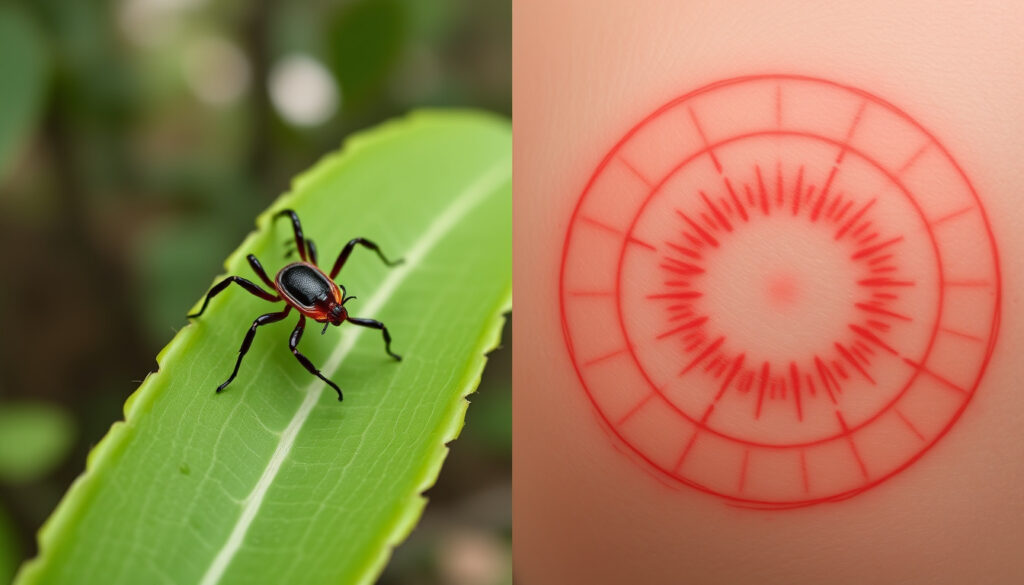
Most people who catch Lyme disease notice something unusual at the site of the tick bite. The erythema migrans rash – often described as a bullseye – appears in about three quarters of cases, according to the HPSC. It can show up anywhere from 3 days to 3 months after the bite, though the HSE says most rashes develop within the first 4 weeks.
Erythema migrans (bullseye rash)
- The rash expands slowly outward from the tick bite, often with a central clearing (CDC)
- It is not painful or itchy, so it can go unnoticed if on the back or scalp (HPSC)
Flu-like symptoms in the first weeks
- Fever, chills, headache, muscle and joint pain, and tiredness are common early symptoms (HSE)
- These can appear even without a noticeable rash (HPSC)
Early localized vs. early disseminated stage
- In the early localized stage, the bacteria remain near the bite site. If untreated, they can spread through the bloodstream (CDC)
- Multiple smaller rashes on other parts of the body signal early dissemination (HPSC)
The rash can be faint and easy to miss, especially if the tick bite was in a hidden spot. Not having a rash does not rule out Lyme disease, so you should not rely on the rash alone to decide whether to seek care.
The implication: a tick bite followed by any flu-like symptom within a month should prompt a visit to your GP, even without a rash.
What happens when you have Lyme disease?
Left untreated, Lyme disease progresses through stages. The HPSC notes that about half of untreated patients go on to develop longer-term complications.
Acute phase (early localized)
- Erythema migrans rash and flu-like symptoms dominate the first few weeks (HSE)
Early disseminated stage (weeks to months)
- Neurological symptoms: facial palsy (droop), meningitis, and shooting pains (HPSC)
- Cardiac problems: heart block and palpitations (CDC)
Late disseminated Lyme disease
- Months after infection, arthritis – especially in the knees – with severe joint swelling can occur (Mayo Clinic)
- Neurological deficits such as memory problems and numbness in the hands or feet may develop (CDC)
The earlier treatment begins, the less likely the infection reaches these later stages. A 14-day course of doxycycline is usually all it takes to stop progression, which is why acting quickly is so important.
The pattern: prompt antibiotic treatment can prevent the most serious outcomes, but delays allow the bacteria to settle in joints, nerves, and heart tissue.
How do you treat Lyme disease?
Both the HSE and HPSC agree that common antibiotics are effective at clearing the infection and preventing complications. Treatment depends on the stage and severity.
Antibiotic course for early stage
- Doxycycline is first-line for adults and children over 8, taken for 14–21 days (CDC)
- Amoxicillin or cefuroxime is used for children under 8 and during pregnancy (HPSC)
Intravenous antibiotics for severe cases
- When Lyme reaches the nervous system (e.g., meningitis) or causes heart block, IV ceftriaxone is given for 14–28 days (Mayo Clinic)
- Hospital referral is needed for severe symptoms (HSE)
Managing post-treatment symptoms
- Some patients experience lingering fatigue and pain for months – known as post-treatment Lyme disease syndrome (CDC)
- No evidence supports additional antibiotics for PTLDS; symptom management is the main approach (HPSC)
The trade-off: standard antibiotics work very well for early Lyme, but the longer treatment is delayed, the greater the chance that symptoms persist beyond the infection itself.
Does Lyme disease ever go away?
With prompt treatment, most patients recover fully. The Mayo Clinic states that the vast majority are cured after an appropriate course of antibiotics. However, a minority continue to face symptoms.
Recovery rates with treatment
- For early localized disease, cure rates exceed 90% with a 2–3 week course (CDC)
- Even later-stage neurological Lyme responds well to IV antibiotics, though recovery may be slower (Mayo Clinic)
Chronic Lyme controversy
- The term “chronic Lyme disease” is not universally accepted; most authorities prefer “post-treatment Lyme disease syndrome” (CDC)
- Prolonged antibiotic therapy for persistent symptoms is not supported by randomized trials (Mayo Clinic)
Post-treatment Lyme disease syndrome (PTLDS)
- PTLDS involves fatigue, sleep disturbances, and cognitive difficulties lasting more than 6 months after treatment (CDC)
- The exact cause is unclear, but it is not an active bacterial infection (HPSC)
The implication: the infection itself almost always clears with antibiotics. The real challenge is managing the residual symptoms that affect a small but significant group.
Is Lyme disease really serious?
Lyme disease can cause severe complications, but death is extraordinarily rare. The CDC reports fewer than 10 fatalities per year in the United States, almost always from Lyme carditis.
Potential complications
- Lyme arthritis: chronic joint swelling, typically in the knee (Mayo Clinic)
- Neuroborreliosis: facial palsy, meningitis, radiculoneuropathy (HPSC)
- Lyme carditis: heart block that can be fatal if untreated (CDC)
Mortality rate
- Deaths are extremely rare; overall mortality is negligible (CDC)
Risk factors and vulnerable populations
- People who spend time in tick habitats (woodlands, tall grass) are at higher risk (HSE)
- Pregnant women can transmit the bacteria to the fetus, though serious outcomes are rare with treatment (CDC)
Lyme disease is serious because of its potential to cause long-term disability, not because it kills. Early treatment virtually eliminates that risk, making vigilance the key to safety.
Why this matters: for most people in Ireland, a tick bite is not a reason to panic – but it is a reason to act quickly.
Step-by-step: what to do if you suspect Lyme disease
- Remove the tick – Use fine-tipped tweezers to grasp the tick as close to the skin as possible and pull upward steadily. Clean the area with antiseptic (HSE).
- Monitor for symptoms – Watch for a rash or flu-like symptoms for up to 30 days after the bite (HPSC).
- See your GP – If you develop a rash or feel unwell, tell the doctor about the tick bite. Early diagnosis is clinical – blood tests are not reliable in the first few weeks (HPSC).
- Start antibiotics – If Lyme disease is suspected, the GP will prescribe doxycycline or amoxicillin. Take the full course, even if you feel better (CDC).
- Follow up – If symptoms persist after treatment, return to the GP. Severe symptoms may require a referral to an infectious disease specialist (HSE).
Confirmed facts and what remains unclear
Confirmed facts
- Lyme disease is caused by Borrelia bacteria transmitted by tick bites (HSE)
- Early antibiotic treatment cures the infection in the vast majority of cases (Mayo Clinic)
- The classic erythema migrans rash is a definitive diagnostic sign (HPSC)
- Lyme disease is not contagious between humans (HSE)
What’s unclear
- The prevalence and definition of chronic Lyme disease remain debated (Mayo Clinic)
- The exact mechanism of post-treatment Lyme disease syndrome is not fully understood (HPSC)
- Effectiveness of long-term antibiotic therapy for PTLDS is not supported by robust evidence (CDC)
- Accurate incidence in Ireland may be underreported due to diagnostic challenges (Tick Talk Ireland)
Lyme disease is spread by the bite of an infected blacklegged tick. The infection can be treated successfully with antibiotics, particularly if it is diagnosed early.
CDC – About Lyme Disease
Most people with Lyme disease get better after antibiotic treatment. It can take months for some people, but the infection itself is usually cleared.
HSE Ireland – Lyme disease factsheet
The best prevention is awareness. Cover up, use repellent, and check for ticks after being outdoors. Early removal of ticks greatly reduces the chance of infection.
lenus.ie, irishpracticenurses.ie, nationalparks.ie, pmc.ncbi.nlm.nih.gov, mayoclinic.org, idsociety.ie
For a comprehensive overview of Lyme disease symptoms, treatment options, and prevention strategies, readers can refer to Lyme disease symptoms and treatment for detailed guidance.
Frequently asked questions
How can I prevent Lyme disease?
Cover skin while walking in grassy or wooded areas, tuck trousers into socks, use insect repellent containing DEET, and check your whole body for ticks after outdoor activities. Prompt removal of ticks reduces infection risk (HSE).
Is Lyme disease contagious from person to person?
No. Lyme disease is spread only through the bite of an infected tick. There is no evidence of person-to-person transmission through casual contact, kissing, or airborne droplets (CDC).
How long does it take to recover from Lyme disease?
With prompt antibiotic treatment, most people recover within a few weeks. Some people experience lingering fatigue and pain for months, but the infection itself is typically cleared by the antibiotics (Mayo Clinic).
What does the Lyme disease rash look like?
The classic rash – erythema migrans – is a red, expanding circle that often has a central clearing, resembling a bullseye. It can appear anywhere from 3 to 30 days after the tick bite and may be very faint. The HPSC notes that about three quarters of cases develop this rash.
Can you get Lyme disease more than once?
Yes. Having Lyme disease once does not provide lifelong immunity. You can be reinfected if you are bitten by another infected tick. Taking prevention measures remains important even if you have had Lyme disease before (CDC).
Should I see a doctor if I find a tick bite?
Not automatically. If you have removed the tick and have no symptoms, you do not need to see a doctor. However, if you develop a rash, fever, or other flu-like symptoms within a month of the bite, see your GP and mention the tick bite (HSE).
Are there blood tests for Lyme disease?
Yes, but they are not useful in the first few weeks because antibodies take time to develop. The HPSC states that blood tests confirm the infection by looking for antibodies to Borrelia burgdorferi, and they are usually positive later in the illness.
More related posts
 Shaun Ryder: Health, Controversies and Heroic Rescue
 Pat Cummins Out of T20 World Cup 2026: Injury, Family, IPL
 Golden Retriever: Temperament, Health, & Costs in Ireland
 Rohit Sharma: Biography, Net Worth, Retirement & Wife
 Sydney Sweeney’s White Lotus Role: Episodes & Character
 Marc Cucurella: Bio, Kids, Chelsea Exit, and Real Madrid Return
 Sevilla FC vs FC Barcelona Lineups: Confirmed XI & Analysis
 Janice Dickinson: Age, Lawsuit and Supermodel Claim