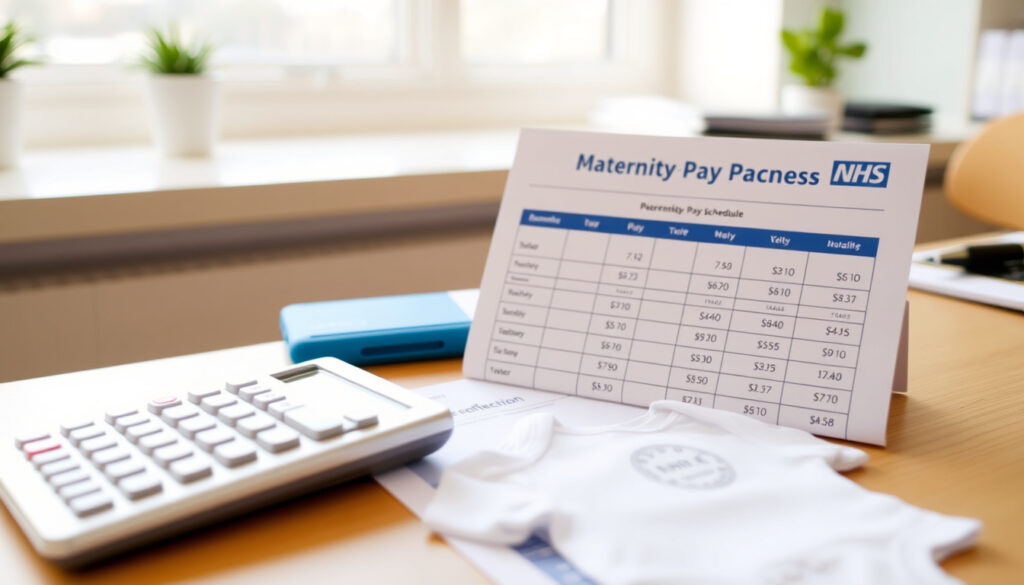
NHS Maternity Pay Calculator 2026/27: OMP and SMP
Few things feel as tangled as trying to figure out exactly what you’ll be paid during maternity leave, especially when you work for the NHS. You’ve heard about ‘full pay’ and ‘half pay’ and something called Statutory Maternity Pay, and somewhere in there is a calculator that’s meant to make sense of it all.
8 weeks full pay + 18 weeks half pay: NHS OMP structure ·
39 weeks SMP total: 6 weeks at 90% of AWE, 33 weeks at £187.18 flat rate ·
12 months service: Minimum for OMP eligibility by 11th week before due date ·
Free calculators: NHS Scotland, BMA, and RCN offer online tools
Quick snapshot
- 8 weeks at full pay (includes all regular allowances) – NHS Scotland Workforce Policies
- 18 weeks at half pay plus Statutory Maternity Pay (SMP) – NHS Scotland Workforce Policies
- 13 weeks of SMP only (subject to eligibility) – NHS Scotland Workforce Policies
- Total payable: up to 39 weeks of combined pay (NHS Scotland Workforce Policies)
- 6 weeks at 90% of average weekly earnings – Royal College of Nursing
- 33 weeks at flat rate £187.18 per week (2026/27) or 90% if lower – Royal College of Nursing
- Available to most employees earning at least £123 per week (Royal College of Nursing)
- Paid by employer, reclaimed from HMRC (Royal College of Nursing)
- Continuous NHS employment of at least 12 months by the 11th week before due date – NHS Scotland Workforce Policies
- Confirmation of pregnancy (maternity certificate MATB1) (NHS Scotland Workforce Policies)
- Must give correct notice and start leave by the 11th week before due date (NHS Scotland Workforce Policies)
- For SMP only: 26 weeks continuous employment and earnings threshold – Royal College of Nursing
- Enter your due date (expected week of childbirth) (British Medical Association)
- Provide average weekly earnings over the 8-week reference period (British Medical Association)
- Input your continuous NHS service length (British Medical Association)
- Receive estimated OMP and SMP amounts for each leave period – British Medical Association
Eight key figures define the NHS maternity pay landscape — here is how they stack up against each other.
The pattern is clear: the first eight weeks are the most generous, followed by a gradual step-down that demands careful budgeting.
| Item | Value |
|---|---|
| Full pay weeks (OMP) | 8 weeks |
| Half pay weeks (OMP + SMP) | 18 weeks |
| SMP-only weeks after OMP ends | 13 weeks (if eligible) |
| Total potentially paid weeks | Up to 39 weeks |
| SMP flat rate (2026/27) | £187.18 per week |
| Average earnings reference period | 8 weeks ending 15th week before due date |
| Minimum service for OMP | 12 months by 11th week before due date |
| Minimum service for SMP only | 26 weeks by 15th week before due date |
How is maternity pay calculated in the NHS?
Understanding Occupational Maternity Pay (OMP) and Statutory Maternity Pay (SMP)
- NHS OMP provides 8 weeks at full pay, followed by 18 weeks at half pay plus SMP, then 13 weeks of SMP only if you remain eligible (NHS Scotland Workforce Policies).
- SMP is 90% of your average weekly earnings (AWE) for the first 6 weeks, then the flat rate of £187.18 per week (2026/27) or 90% of your AWE if that is lower for the remaining 33 weeks (Royal College of Nursing).
- Your AWE is calculated over the 8-week period ending with the 15th week before your expected week of childbirth (GOV.UK).
The implication: your total income during leave follows a predictable three-phase schedule — it does not stay level, but the drop-off points are fixed and knowable.
Step-by-step calculation using average weekly earnings
- Identify your expected week of childbirth (EWC) from your MATB1 certificate.
- Count back 15 weeks from the Saturday of your EWC to find the end of your reference period.
- Add up all gross pay (including regular allowances and overtime) over the 8 weeks ending on that Saturday.
- Divide by 8 to get your AWE — this figure determines both your SMP rate and your OMP half-pay baseline.
- Check your continuous NHS service length: 12 months by the 11th week before your due date qualifies you for full OMP (NHS Scotland Workforce Policies).
- Apply the schedule: weeks 1–8 at full pay, weeks 9–26 at half pay plus SMP, weeks 27–39 at SMP only.
What this means: the hardest part is gathering the pay records for the 8-week window. Once you have that number, the rest is arithmetic.
NHS staff who qualify for OMP effectively receive more than triple the SMP-only amount during the first 8 weeks. A midwife earning a typical £2,400 per month would see roughly £2,400 per month in phase one drop to about £1,800 per month in phase two, then to approximately £750 per month in phase three.
NHS maternity pay calculator tools and how to use them
- The NHS Scotland maternity leave calculator at workforce.nhs.scot estimates your leave dates and pay entitlement — it is the only official NHS calculator covering OMP and SMP together (NHS Workforce Policies calculator page).
- The BMA maternity leave calculator helps members across the UK track key notification dates and estimate pay (British Medical Association).
- The GOV.UK employer calculator computes SMP, paternity, and adoption pay for employers but is currently flagged as being updated (GOV.UK).
- Third-party tools like maternitycalculator.co.uk offer NHS-specific estimates based on the 8+18+13 week model (Maternity Calculator UK).
The catch: no single authoritative calculator exists for NHS England staff the way NHS Scotland has one. You may need to cross-check results from two tools to be certain.
Do NHS employees get full maternity pay?
Eligibility criteria for full pay under the NHS scheme
- You must have 12 months of continuous NHS employment by the beginning of the 11th week before your due date (NHS Scotland Workforce Policies).
- You must provide a MATB1 maternity certificate (issued after week 20 of pregnancy).
- You must give written notice of your intended maternity leave start date at least 28 days before it begins.
- For SMP-only eligibility, you need 26 weeks of continuous employment up to the qualifying week and average weekly earnings of at least £123 (Royal College of Nursing).
The trade-off: the 12-month service rule for OMP locks out newer hires, but the SMP safety net still catches staff who have worked at least 26 weeks.
What ‘full pay’ means in the NHS context
Full pay under the NHS scheme includes your basic salary, all regular allowances (unsocial hours, weekend enhancements, recruitment and retention premia), and pension contributions — your take-home during the first 8 weeks matches what you would earn while working (Royal College of Nursing).
What this means: if you typically earn overtime or bank shifts, only the regular, contracted elements are guaranteed. Variable extra shifts worked during the 8-week reference period are included in your AWE calculation but are not guaranteed to continue during leave.
Partial pay and the role of SMP after the initial weeks
- From weeks 9 to 26, you receive half your normal salary plus full SMP. The half-pay is calculated on your regular earnings without enhancements.
- From weeks 27 to 39, OMP ends and you receive SMP only — £187.18 per week or 90% of your AWE if lower.
- After week 39, maternity leave can continue unpaid for up to 52 weeks total (NHS Scotland Workforce Policies).
Can I spread my NHS maternity pay over 12 months?
Spreading options: how the NHS allows flexible pay
- Some NHS trusts offer a pay smoothing or levelling arrangement where your total maternity pay is divided evenly over 12 months instead of following the standard three-phase schedule.
- This does not change the total amount you receive — it redistributes the same total over a longer period.
- Spreading is not a statutory right; each trust decides whether to offer it, and the policy varies across England, Scotland, and Wales.
The implication: smoothing helps with monthly cash flow but delays access to the higher early payments. If you need the lump sum up front for large expenses, the standard schedule may suit you better.
Impact on income tax and national insurance
Spreading your pay does not reduce your overall tax or National Insurance liability — you pay the same total tax on the same total income. However, spreading may keep you within a lower marginal tax bracket each month, which can slightly reduce the amount of tax deducted in higher-earning months. Your employer handles the payroll adjustments through standard PAYE (GOV.UK).
How to request spreading from your NHS employer
- Check your trust’s maternity policy — look for terms like “pay smoothing”, “levelling”, or “equalised payments”.
- Speak to your HR or payroll department before your leave starts; spreading arrangements must typically be agreed in advance.
- Submit a written request outlining your preference and confirming you understand the total paid remains unchanged.
- Get the agreement in writing — verbal approvals are not reliable for payroll adjustments.
If your trust does not offer spreading, there is no appeal route — it is a discretionary scheme. Employees at trusts that do offer it report improved budgeting, but the arrangement locks you into lower monthly payments during the first 8 weeks when the standard schedule would pay the most.
How does maternity leave and pay affect the NHS pension?
Pension contributions during maternity leave
- Your pension contributions continue automatically during full-pay and half-pay weeks, calculated on the actual salary you receive.
- During SMP-only weeks (weeks 27–39), contributions are based on your SMP rate, which is substantially lower than your normal salary.
- During unpaid leave (after week 39), contributions stop unless you arrange to make them yourself.
The catch: lower contributions during SMP-only and unpaid periods mean your pension accrual slows down, even though your service may still count toward your final pension benefits.
Monthly pension accrual while on OMP and SMP
Your NHS pension builds up at the same accrual rate during maternity leave as during normal work, provided contributions are being made. The difference is the amount of pensionable pay — in the SMP-only phase, a much lower salary base and lower member contributions mean a smaller benefit build-up for that period. This matters most for staff on the 2015 NHS Pension Scheme, where benefits are career-average rather than final-salary (British Medical Association).
Options to buy back additional pension after leave
The NHS Pension Scheme allows members to make Additional Pension Contributions (APCs) to fill gaps in pensionable service caused by unpaid leave or reduced pay periods. You must apply within 12 months of returning to work, and the cost is based on your age and the amount of service you want to restore. This is a valuable option for staff who take extended unpaid leave beyond week 39 and want to avoid a permanent reduction in their career-average benefits.
For a mid-career NHS employee earning £38,000 per year, taking the full 52 weeks of leave with 13 weeks unpaid could reduce pensionable service by roughly 0.25 years. Buying back that gap with APCs costs a few hundred pounds but restores the full pension benefit — a trade-off worth calculating before you return to work.
How does paternity pay differ from maternity pay in the NHS?
NHS paternity pay entitlement
- NHS paternity leave offers 2 weeks of full pay (compared to 8 weeks for maternity), plus Statutory Paternity Pay (SPP) at the flat rate or 90% of AWE if lower.
- Eligibility requires 26 weeks of continuous NHS service by the 15th week before the due date.
- Paternity leave must be taken within 56 days of the birth, in one consecutive block of 1 or 2 weeks.
The contrast: the full-pay window for paternity is one-quarter the length of maternity. The eligibility threshold is lower (26 weeks vs 12 months), but the total paid weeks are far fewer.
Shared parental leave and pay
Shared Parental Leave (SPL) allows eligible parents to split the remaining maternity leave after the mother’s compulsory 2 weeks. This means a partner can take several months off while the mother returns to work early. SPL pay follows the same SMP structure: 90% of AWE for the first 6 weeks, then flat rate. Eligibility requires both parents to meet employment and earnings tests (Royal College of Nursing).
Key differences in pay rates and duration
- Maternity: 8 weeks full pay, 18 weeks half pay plus SMP, 13 weeks SMP only, then unpaid up to week 52.
- Paternity: 2 weeks full pay, then unpaid or SPP only for additional weeks (no extended half-pay phase).
- Shared parental: Up to 50 weeks split between parents, paid at SMP rates for eligible weeks, with no guaranteed full-pay period beyond the mother’s initial 8 weeks.
The trade-off: paternity pay is shorter but easier to qualify for. Shared parental leave offers flexibility but replaces the longer OMP full-pay period for the mother, so families need to weight the financial impact carefully.
What’s the timeline for NHS maternity pay and leave?
- 15th week before due date: Reference period for AWE ends; employee must have 26 weeks’ continuous service for SMP.
- 11th week before due date: Employee must have 12 months’ continuous NHS service for OMP; notice of leave start date required.
- Earliest leave start: Up to 11 weeks before due date; compulsory leave starts from the day of birth.
- Weeks 1–8: NHS OMP full pay (100% of salary plus allowances).
- Weeks 9–26: NHS OMP half pay plus SMP (combined).
- Weeks 27–39: SMP only, if eligible — OMP exhausted.
- After week 39: Maternity leave may continue unpaid for up to 52 weeks total (NHS Scotland Workforce Policies).
What’s confirmed and what’s still unclear about NHS maternity pay
Confirmed facts
- NHS OMP for England and Wales: 8 weeks full pay, 18 weeks half pay plus SMP, 13 weeks SMP (NHS Scotland Workforce Policies).
- SMP flat rate for 2026/27: £187.18 per week (GOV.UK).
- Average weekly earnings based on 8-week reference period ending 15th week before EWC (Royal College of Nursing).
- NHS Scotland OMP structure identical (8 full, 18 half) (NHS Scotland Workforce Policies).
What’s unclear
- Precise number of NHS trusts offering pay spreading varies; not a statutory right.
- Exact impact of variable overtime on average earnings may differ by trust policy.
- Pension contribution rates during unpaid leave depend on individual trust and scheme rules.
NHS employees who meet the 12-month service threshold are entitled to 8 consecutive weeks at their full normal salary, followed by 18 weeks at half salary plus statutory pay, and then 13 weeks of statutory pay alone. This is the most generous arrangement among public sector health services in the UK.
— NHS Employers Terms and Conditions handbook
The six-week period at 90% of average earnings is designed to cover the immediate postpartum period when medical needs and recovery are highest. After that, the flat-rate SMP reflects a shift toward longer-term income support.
— Royal College of Nursing family toolkit
Shared parental leave lets families decide how to divide care responsibilities, but the financial trade-off is real — the mother’s full-pay OMP weeks cannot be transferred, so families using SPL typically see lower total household income during the first 8 weeks.
— British Medical Association maternity pay guide
The NHS Scotland maternity leave calculator remains the only official online tool that combines OMP eligibility, SMP calculations, and leave dates in one interface. No equivalent exists for NHS England.
— NHS Scotland Workforce Policies
For NHS staff planning maternity leave, the core decision is not whether the pay is good — it is whether you can manage the income drop at week 27 when OMP ends and you rely on SMP alone. If your trust offers pay smoothing, that option trades higher early payments for consistent monthly income across the full year. If your pension gap after unpaid leave matters to you, Additional Pension Contributions let you restore lost service within 12 months of returning. For families comparing maternity and paternity options, the shorter paternity full-pay window makes shared parental leave appealing for flexibility, but the financial maths rarely favours splitting the mother’s OMP entitlement.
For a broader view of NHS compensation, you can also check the NHS Band 6 pay scales for 2026/27.
Frequently asked questions
What is the difference between OMP and SMP in the NHS?
Occupational Maternity Pay (OMP) is the NHS-specific scheme providing 8 weeks full pay and 18 weeks half pay. Statutory Maternity Pay (SMP) is the government minimum paid by all employers — 6 weeks at 90% of AWE and 33 weeks at flat rate. NHS staff who qualify for OMP receive both: OMP tops up SMP during the first 26 weeks, then SMP continues alone for weeks 27 through 39.
How do I know if I am eligible for NHS occupational maternity pay?
You qualify for OMP if you have at least 12 months of continuous NHS employment by the beginning of the 11th week before your due date. You also need to provide a MATB1 certificate, give written notice of your leave start date, and begin leave by the 11th week before your expected week of childbirth (NHS Scotland Workforce Policies).
Can I take maternity leave before my due date?
Yes — you can start maternity leave up to 11 weeks before your expected week of childbirth. Compulsory maternity leave begins on the day your baby is born, regardless of when you planned to start leave.
How do I calculate my average weekly earnings for NHS maternity pay?
Your average weekly earnings are calculated by adding up all gross pay (including regular allowances and paid overtime) over the 8-week period ending with the Saturday of the 15th week before your due date, then dividing by 8 (Royal College of Nursing).
What happens to my NHS pension during maternity leave?
Pension contributions continue automatically during full-pay and half-pay weeks based on your actual salary. During SMP-only weeks, contributions are based on the lower SMP rate. During unpaid leave, contributions stop unless you arrange Additional Pension Contributions (APCs) within 12 months of returning to work.
Can I take shared parental leave instead of maternity leave?
Yes — Shared Parental Leave allows eligible parents to split the remaining leave after the mother’s compulsory 2 weeks. The mother’s 8-week OMP full-pay period cannot be transferred, so families taking SPL typically receive lower total pay during the first 8 weeks.
How does paternity pay work for NHS employees?
NHS paternity leave provides 2 weeks of full pay (not 8), plus Statutory Paternity Pay at the flat rate or 90% of AWE. You need 26 weeks of continuous NHS service by the 15th week before the due date, and must take the leave within 56 days of the birth in one consecutive block (Royal College of Nursing).
Related reading: Band 6 Nurse Salary 2025/26: UK NHS vs Ireland HSE · UK State Pension DWP 2025: Rates, Savings & New vs Basic
More related posts
 Kirk Douglas: Life, Career, Charitable Will, and Stroke Recovery
 Gian Van Veen: Dartitis, Nickname & PDC Career
 Karlie Kloss: Feuds, Family, and Why She Left Modeling
 10 Weeks From Today: Date Calculator, Pregnancy & Business Days
 Drew Pritchard: Split, New Store, Net Worth & Salvage Hunters
 Megan Stalter: Biography, Age, and Career
 Calvert Lewin: biography, age, height, stats, wife and career
 Lia Thomas: NCAA Title, Policy Shift & 2025 Consent Decree