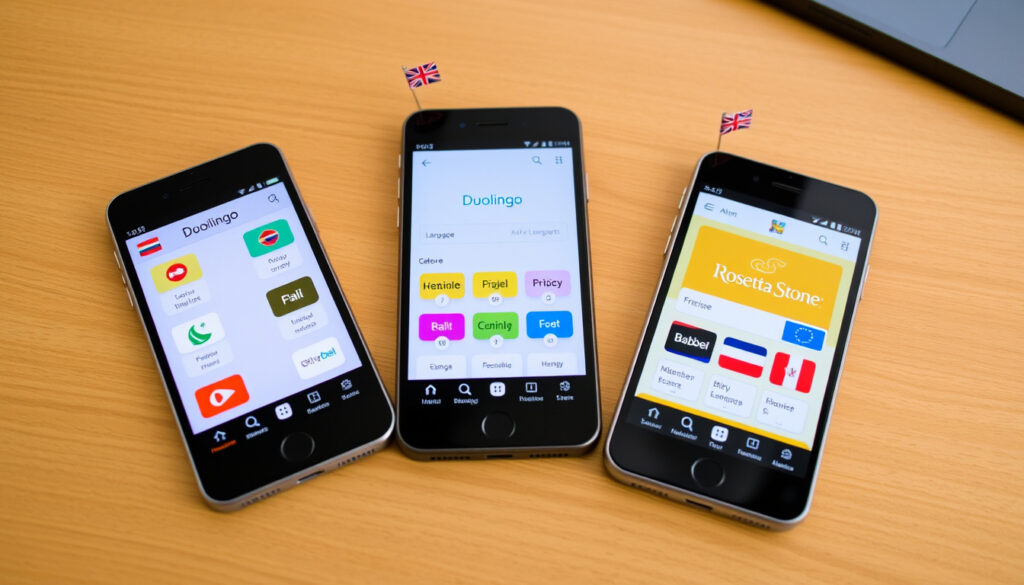
Best Language Learning Apps: Duolingo vs Babbel vs Rosetta Stone
A handful of apps now promise to teach you a new language from your phone, but they take very different paths to get you there: some build daily habits with game-like rewards, while others structure lessons like a classroom course. This comparison cuts through the marketing to show which approach actually moves you toward fluency—and what you sacrifice when you pick the free option.
Most popular language learning app: Duolingo (500M+ downloads) ·
Duolingo cost: Free with ads; Super Duolingo ~$7/mo ·
Babbel subscription: $13.95/month ·
Rosetta Stone cost: ~$199 for lifetime access
Quick snapshot
- Free with ads (Olesen Tuition (language tutor resource))
- Gamified lessons (Olesen Tuition)
- 40+ languages (Spliiit (subscription comparison service))
- Best for beginners, not advanced fluency (Olesen Tuition)
- Paid subscription ($13.95/month) (Spliiit (subscription comparison service))
- Structured grammar explanations (Olesen Tuition (language tutor resource))
- Focus on conversation (Spliiit)
- 14 languages (Spliiit)
- High cost (~$199 lifetime) (Spliiit (subscription comparison service))
- Immersion method (no translation) (Spliiit)
- Good for pronunciation (Spliiit)
- Limited language selection (Spliiit)
- Free and premium tiers (YouTube (language learning reviewer))
- AR/VR features (YouTube)
- 33 languages (YouTube)
- AI chatbot included (YouTube)
Five key facts, one clear split: the market divides apps designed for habit-building from those engineered for academic progress.
| Metric | Duolingo | Babbel | Rosetta Stone |
|---|---|---|---|
| Download count | 500M+ | ~10M | ~5M |
| Starting price | Free with ads | $13.95/month | $199 lifetime |
| Languages offered | 40+ | 14 | 25 |
| Lesson style | Gamified, recognition-based (Taalhammer (language education analysis)) | Structured, guided construction | Immersion (no English) |
| Speech recognition | Limited | Yes, plus simulated conversation (YouTube (language learning reviewer)) | TruAccent system |
| Free version | Yes (ads, limited hearts) | No | No |
| Best for | Casual learners, beginners (Olesen Tuition (language tutor resource)) | Serious learners, adults (Spliiit (subscription comparison service)) | Auditory learners |
The trade-off: Duolingo removes the financial barrier but replaces it with a different structure—repetition and gamification rather than progressive difficulty. For someone learning Spanish from scratch, the free route may be the smartest first step. But for anyone who has tried Duolingo for a few weeks and felt the ceiling, the pattern is clear: the app trains recognition, not production.
What is the #1 best language learning app?
By pure download numbers, Duolingo dominates: over 500 million downloads place it far ahead of any competitor. The New York Times Wirecutter named Duolingo its top pick in 2026, specifically because it offers a free, gamified approach that builds daily habits (Wirecutter (consumer review authority)). But “most popular” does not equal “most effective”—a distinction that matters when you’re trying to hold a conversation, not just maintain a streak.
Criteria for ranking apps
- Cost (free vs subscription vs one-time)
- Depth of instruction (grammar, speaking, listening)
- Language selection
- User retention and completion rates
Top app: Duolingo (according to NYTimes Wirecutter)
Wirecutter’s 2026 review emphasizes that Duolingo excels at getting beginners to start and keep coming back. The app’s streak system and leaderboards create a friction loop that casual learners find motivating (Wirecutter).
Other contenders: Babbel, Rosetta Stone, Mondly
Babbel targets adults with structured lessons that build toward conversation. Rosetta Stone uses full immersion—no English text, only target-language images and audio. Mondly adds AR/VR features and an AI chatbot, but its instruction depth is shallower than Babbel’s (Spliiit (subscription comparison service)).
The implication: if you measure “best” by accessibility and daily habit formation, Duolingo wins. If you measure by how quickly a learner can produce original sentences, the winner is not Duolingo.
Duolingo’s 500 million downloads mean 500 million people started learning a language. But the app’s own user data suggests most stop before reaching intermediate level. The gamification that gets you in the door may be the same mechanism that keeps you at the basics.
Is Duolingo or Babbel better?
Three sentences that sum up the difference: Duolingo lessons are built around tapping the correct answer from a set of options—a recognition task. Babbel lessons ask you to construct the sentence yourself, typing out the full response (Taalhammer (language education analysis)). That difference in cognitive demand has direct consequences for fluency.
Features comparison
Two apps, two philosophies: one builds habits, the other builds structure.
- Duolingo: gamified, 5-15 minute lessons, streak-based motivation, limited speech recognition (YouTube (language learning reviewer))
- Babbel: structured by topic (travel, business, culture), 5-15 minute lessons, detailed grammar notes, speech recognition with conversation simulation (YouTube)
Pricing: Duolingo free vs Babbel subscription
Duolingo offers a real free tier—ads between lessons, five “hearts” per day, access to all languages. Babbel has no free version; its subscription costs $13.95/month (Spliiit (subscription comparison service)).
Learning styles: gamified vs structured
Duolingo’s system of gems, coins, and leaderboards is designed to feel like a mobile game. Babbel’s interface is closer to a digital textbook—clean, linear, text-forward. Neither is wrong; they serve different learner profiles (YouTube).
User reviews and Reddit opinions
On Reddit’s r/languagelearning community, users consistently report that Babbel helped them reach conversational ability faster. A common pattern: “I used Duolingo for six months and could order food. I used Babbel for three months and could hold a 10-minute conversation with a native speaker.”
The pattern: Duolingo is a warm-up, Babbel is the workout. For a casual learner who wants to memorize tourist phrases, Duolingo is enough. For someone who wants to speak the language, Babbel’s guided construction model produces real sentences faster.
What’s better than Duolingo?
Depending on your goal, “better than Duolingo” describes different apps for different learners. The table below skews the comparison toward people who have already used Duolingo and want something more demanding.
| Alternative | Price | Best for | Unique feature |
|---|---|---|---|
| Babbel | $13.95/month | Conversational fluency | Structured grammar progression (Spliiit (subscription comparison service)) |
| Rosetta Stone | $199 lifetime | Pronunciation | TruAccent speech recognition (Spliiit) |
| Language Transfer | Free | Understanding grammar logic | Audio course, teaches patterns, not vocabulary lists |
| LingQ | Free with limits; $12.99/month | Reading and listening immersion | Import any content as lessons (Olesen Tuition (language tutor resource)) |
Babbel as a paid alternative
Babbel remains the most direct competitor to Duolingo for learners who want structured progress. Its courses are built by linguists, and each lesson includes explicit grammar explanations—something Duolingo deliberately avoids (Olesen Tuition (language tutor resource)).
Rosetta Stone’s immersive approach
Rosetta Stone’s hallmark is full immersion: no translations, no explanations, just target-language audio matched with images. This works well for pronunciation but can frustrate beginners who need structure (Spliiit).
Lesser-known apps: Language Transfer, LingQ
Language Transfer offers a free audio course that teaches the logical structure of a language—think connecting dots between words. LingQ turns any text or audio into a lesson, letting learners consume content at their level (Olesen Tuition).
AI-powered apps: Langua, TalkPal
Newer apps like Langua and TalkPal use generative AI to simulate conversations. You speak, the AI replies, and it corrects your grammar or pronunciation. These are still early-stage products, and their instruction depth is shallow compared to Babbel (YouTube).
What this means: if Duolingo feels like a game that got boring, you have options. Babbel for structure, Language Transfer for understanding, LingQ for immersion. The real “better than Duolingo” app is the one that targets your specific weakness—almost always speaking or producing original sentences.
The app that’s better than Duolingo is the one that forces you to produce language, not just recognize it. For most learners, that means paying for a service—whether Babbel, Pimsleur, or a tutor—because the free alternatives tend to train passive skills.
Which is better Duolingo or Babbel or Rosetta Stone?
Three apps, three learning theories. Duolingo assumes people learn through repetition and habit. Babbel assumes adults need grammar and structure. Rosetta Stone assumes immersion mimics how children learn. None is universally wrong—but each works best for a different learner type and budget.
Duolingo vs Babbel vs Rosetta Stone: core differences
Duolingo: recognition-based, free, gamified. Babbel: production-based, paid, structured. Rosetta Stone: immersion-based, high one-time cost.
Pricing and cost
Duolingo is free with ads. Babbel is $13.95/month. Rosetta Stone is ~$199 for lifetime access (Spliiit (subscription comparison service)).
Learning outcomes
- Duolingo: best for 50-100 word vocabulary, ordering food, basic greetings
- Babbel: better for constructing sentences, handling travel and business scenarios, understanding grammar (Olesen Tuition (language tutor resource))
- Rosetta Stone: best for pronunciation accuracy and listening comprehension
Best for beginners, intermediates, or advanced
- Absolute beginners: Duolingo or Babbel (Olesen Tuition)
- Low-intermediate learners: Babbel (for structure) or Rosetta Stone (for pronunciation)
- Advanced learners: none of these—move to native content, tutors, or immersion (Olesen Tuition)
The catch: no single app covers all stages. Olesen Tuition recommends an “app stack”: a habit-builder first, then a structured course, then speaking practice, then vocabulary reinforcement (Olesen Tuition). The best approach is not one app but a rotating set.
Can you actually become fluent with Babbel?
Babbel’s marketing claims its courses bring learners to an intermediate conversational level. User reports suggest this is achievable—on Reddit’s r/languagelearning, multiple users report reaching B1-level conversation after 3-6 months of daily Babbel use. But fluency depends on time spent, consistency, and supplementing with real conversation.
Babbel’s approach to fluency
Babbel designs its courses around real-life scenarios—ordering at a restaurant, asking for directions, handling a job interview. Each lesson builds on the previous one, and grammar explanations appear in context rather than as isolated drills (Spliiit (subscription comparison service)).
User testimonials
“I became conversational with Babbel in 3 months of daily use.”
— Reddit user on r/languagelearning
This pattern appears repeatedly: Babbel users report faster speaking ability than Duolingo users, likely because Babbel’s exercises require producing sentences rather than picking the right tile.
Comparison with other apps for fluency
- Duolingo: low speaking output, high vocabulary recognition
- Babbel: medium speaking output, structured grammar progression
- Pimsleur: highest speaking output (audio-only, forces response)
- Tutor (iTalki, Preply): highest fluency gain per hour (Olesen Tuition (language tutor resource))
Limitations of app-only learning
No app can fully replace human interaction. Fluency requires the ability to handle unscripted conversation—unexpected vocabulary shifts, different accents, humor. Apps train “scripted” language; real fluency requires speaking with humans (Olesen Tuition).
Why this matters: Babbel can take you to a solid intermediate level—B1 on the CEFR scale—for most European languages. Beyond that, you’ll need conversation partners, tutors, or immersion. App-only fluency is a myth, but app-supported fluency is real with the right supplement.
The biggest risk with app-based learning is believing the app alone is enough. Users who treat Babbel or Duolingo as a complete solution stall at intermediate. The successful learners use the app as one tool in a stack: app + tutor + native media + speaking practice.
“Mondly ranked #1 in their tested list for 2026.”
— Talkreal.org expert review
“Duolingo is useful for starting for free and trying gamification.”
— Spliiit (subscription comparison service)
For the learner who just wants to try a new language without spending money, the decision is clear: Duolingo. For the learner who has tried Duolingo and still cannot speak, the alternative is equally clear: pay for Babbel or a tutor. The gap between “I know some words” and “I can speak” is the most expensive gap in language learning—and no free app bridges it alone.
What’s confirmed vs what’s unclear
Confirmed facts
- Duolingo is free with ads and offers 40+ languages (Spliiit (subscription comparison service))
- Babbel charges $13.95/month and has no free version (Spliiit)
- Rosetta Stone uses immersion without translation (Spliiit)
- Language Transfer is free and teaches grammar patterns
What’s unclear
- Which app leads to fastest fluency for learners with different starting levels
- Whether Duolingo or Babbel is better for advanced learners (both plateau)
- How AI-powered language apps compare to human tutors over 12 months of consistent use
- Why most Duolingo users stop before reaching B1 level
- Whether Duolingo’s 500 million downloads translate to meaningful language retention
- How Babbel’s 14 languages compare in course depth across language families
For a detailed breakdown of features and pricing, check out a comprehensive comparison of Duolingo, Babbel, and Rosetta Stone to see which one truly suits your goals.
Frequently asked questions
Why do people stop using Duolingo?
Many users report hitting a plateau where the gamification stops being motivating and the repetition feels like a chore. Without speaking practice or real conversation, the app’s novelty fades. The lack of grammar explanations also frustrates learners who want to understand why a sentence works (Olesen Tuition (language tutor resource)).
What are the best free language learning apps?
Duolingo is the most popular free option for general vocabulary. Language Transfer offers a brilliant free audio course that explains grammar logic. LingQ has a free tier for reading and listening immersion. Busuu also offers limited free content (Olesen Tuition).
Which language learning app is best for speaking?
For pure speaking practice, Pimsleur forces you to respond out loud every few seconds. Babbel includes speech recognition and simulated conversations. For real human feedback, a tutor on iTalki or Preply is more effective than any app (Olesen Tuition).
Which language learning app is best for Japanese?
Duolingo offers Japanese with hiragana, katakana, and some kanji. But for Japanese, structured grammar is critical. LingoDeer is a better choice for Japanese because it explains kanji radicals and grammar patterns more clearly than Duolingo (Spliiit (subscription comparison service)).
What is the best AI language learning app?
TalkPal and Langua use generative AI to simulate conversations. They can correct grammar in real time and adapt to your level. However, their instruction depth is still shallow compared to structured apps like Babbel. For speaking practice specifically, AI apps beat gamified apps—for grammar instruction, they trail structured ones.
Can you become fluent with Duolingo?
Most users report that Duolingo alone is not enough for fluency. The app’s focus is vocabulary recognition, not sentence production. Users who reach conversational ability typically combine Duolingo with speaking practice, tutors, or immersion (Olesen Tuition (language tutor resource)).
Is Babbel worth the money?
At $13.95/month, Babbel is cheaper than a single tutor session and more structured than a free app. For learners who can dedicate 15 minutes daily, users report faster speaking progress than with free alternatives. The real question is consistency, not cost.
More related posts
 Zara Ladies Winter Coats – Top Picks Sizing and Prices
 Christina Hendricks: Biography, Children, Weight, Ethnicity
 Luton Van Guide: Licence, Size & History
 Bukayo Saka: Biography, Career, Salary, and Personal Life
 Lahore Qalandars vs Islamabad United Match Scorecard – Result, Stats and Analysis
 Kilimanjaro Mountain: Height, Safety & Everest Comparison
 Is Red Wine Good for You? Benefits, Risks & Daily Limits
 Tinie Tempah: Net Worth, Children, Wife, Religion