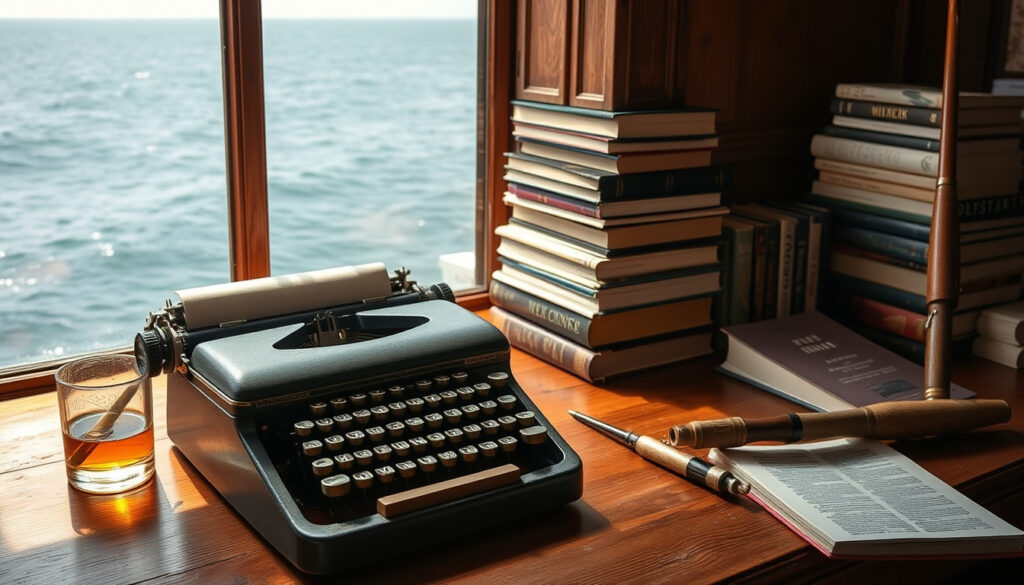
Ernest Hemingway: Life, Works, and Death Profile
Few American writers have shaped the public imagination quite like Ernest Hemingway—the war correspondent, the deep-sea fisherman, the man who made brevity an art form. Behind the bravado and the Nobel Prize lay a life of serious health struggles, FBI surveillance, and a final act that still sparks debate, a quiet contradiction between public persona and private reality.
Born: July 21, 1899, Oak Park, Illinois ·
Died: July 2, 1961, Ketchum, Idaho ·
Nobel Prize in Literature: 1954 ·
Notable Works: The Old Man and the Sea, A Farewell to Arms, For Whom the Bell Tolls ·
Spouses: Hadley Richardson, Pauline Pfeiffer, Martha Gellhorn, Mary Welsh
Quick snapshot
- Born 1899 in Oak Park, Illinois (Ernest Hemingway Birthplace Museum)
- Died by suicide on July 2, 1961 (PBS NewsHour)
- Won Nobel Prize in Literature in 1954 (Biography.com)
- Whether he was fully sober for the full three months before his death is contested by some accounts (PBS NewsHour)
- Exact nature of some personal relationships remains speculative (JSTOR)
- FBI file opened in 1942, closed in 1974 — 127 pages, 15 blacked out (Springer)
- Three months of sobriety before death in July 1961 (Biography.com)
Six key facts about Hemingway, one pattern: his life was a series of extremes — from literary triumph to physical collapse, from wartime heroism to institutional paranoia.
| Label | Value |
|---|---|
| Full Name | Ernest Miller Hemingway |
| Born | July 21, 1899, Oak Park, Illinois, U.S. |
| Died | July 2, 1961, Ketchum, Idaho, U.S. |
| Notable Awards | Nobel Prize in Literature (1954), Pulitzer Prize for Fiction (1953) |
| Genres | Novel, short story, journalism, travel writing |
| Spouses | Hadley Richardson, Pauline Pfeiffer, Martha Gellhorn, Mary Welsh |
What is Ernest Hemingway most famous for?
His literary style and influence
Hemingway is celebrated for his economical, understated prose style — often called the “iceberg theory” because the deeper meaning of a story should not be evident on the surface. His sentences were short, his dialogue sharp, and his descriptions stripped of ornament. This approach, developed during his Paris years in the 1920s, influenced generations of writers from J.D. Salinger to Raymond Carver (Encyclopædia Britannica).
Key themes in his work
- War, love, and loss — explored in A Farewell to Arms (1929) and For Whom the Bell Tolls (1940)
- Masculinity and grace under pressure — embodied by Santiago in The Old Man and the Sea (1952)
- The futility of glory — seen in his short stories like “The Snows of Kilimanjaro”
His work often explores themes of war, love, loss, and masculinity (Biography.com).
Awards and recognition
He won the Nobel Prize in Literature in 1954, officially cited for “his powerful, style-forming mastery of the art of modern narration” (Nobel Prize Foundation). Two years earlier, The Old Man and the Sea had won the Pulitzer Prize for Fiction in 1953 (Pulitzer Prize Board).
The implication: style and substance fused in Hemingway’s work to create a literary legacy that outlasted his personal turmoil.
What led to Ernest Hemingway’s death?
Final years and health decline
By the late 1950s, Hemingway’s physical and mental health had deteriorated sharply. He suffered from severe depression, paranoid delusions, and bipolar disease, all exacerbated by alcoholism and repeated head injuries (PBS NewsHour). A psychological autopsy published in PubMed describes his alcohol dependence as part of a complex comorbidity alongside mood disorder and traumatic brain injury (PubMed). He was also convinced the FBI was monitoring him — a belief that turned out to be partly true.
Events of July 2, 1961
On the morning of July 2, 1961, at his home in Ketchum, Idaho, Hemingway died by suicide from a self-inflicted shotgun wound (Ernest Hemingway Birthplace Museum). He was 61. The New York Times obituary initially quoted his wife Mary as saying he had “accidentally killed himself while cleaning a gun” (PBS NewsHour).
Conflicting theories about his state of mind
- Some accounts emphasize his paranoia about the FBI, which was later confirmed by the release of his FBI file (FBI Vault)
- Others point to his alcohol dependence and traumatic brain injuries as primary drivers (PubMed)
- He had been sober for three months prior to his death — a fact that complicates the narrative of a drunken suicide (Biography.com)
The implication: Hemingway’s death was not a simple act of despair but the culmination of multiple intersecting health crises — documented in his medical records and his FBI file.
The public myth of Hemingway as a hard-drinking, macho adventurer collides with medical reality: a man who was sober, terrified, and under surveillance when he died. For anyone studying the link between mental health and artistic genius, his case is a cautionary tale — not a romantic one.
What is Ernest Hemingway’s most famous book?
The Old Man and the Sea: themes and acclaim
The Old Man and the Sea (1952) is often cited as his most famous work. It tells the story of Santiago, an aging Cuban fisherman who battles a giant marlin in the Gulf Stream. The novel won the Pulitzer Prize for Fiction in 1953 (Pulitzer Prize Board) and was a key factor in his Nobel Prize win the following year (Nobel Prize Foundation).
Other major novels
- The Sun Also Rises (1926) — captured the disillusionment of the post-WWI “Lost Generation”
- A Farewell to Arms (1929) — a semi-autobiographical war romance set in Italy
- For Whom the Bell Tolls (1940) — set during the Spanish Civil War
Critical reception and popularity
While The Old Man and the Sea remains his most commercially successful and widely taught book, critics often regard A Farewell to Arms as his finest novel (Encyclopædia Britannica). The trade-off: his later work is more famous, but his mid-career novels are considered more technically accomplished.
What were Ernest Hemingway’s last words?
Reported final utterances
According to Mary Hemingway, his last words were something like “Goodnight, my kitten” — spoken to her on the evening of July 1, 1961 (PBS NewsHour). He died the next morning.
Verification and sources
Mary Hemingway’s account is the only primary source for these words. The New York Times obituary relayed the “cleaning a gun” explanation, but Mary later clarified the circumstances in a 1966 memoir (How It Was).
Context of his final hours
He had been released from the Mayo Clinic in Rochester, Minnesota, just a week earlier, after receiving electroconvulsive therapy for depression. He was under the care of a doctor in Ketchum and was reportedly sober (Biography.com).
Was Hemingway LGBTQ?
Speculation and historical analysis
No definitive evidence confirms Hemingway was LGBTQ. However, some scholars have noted his intense relationships with men and his preoccupation with masculinity as a possible sign of fluid sexuality. He was married four times to women and had children (Encyclopædia Britannica).
Biographers’ views
Most biographers — including James Mellow and Michael Reynolds — do not argue that Hemingway was gay or bisexual. Some contemporary critics, like Carl Eby, have suggested that Hemingway’s gender identity was more complex than the macho image allowed (JSTOR).
Hemingway’s own statements
Hemingway publicly expressed homophobic views in his writing and interviews, but scholars warn against taking these at face value. The pattern: what he said publicly often contradicted what he explored privately in drafts and letters.
Was Hemingway’s macho posturing merely a front?
Contradictions in his public persona
Hemingway cultivated a rugged, hyper-masculine image — deep-sea fishing, big-game hunting, bullfighting, and four marriages. But his fiction often explores vulnerability, fear, and failure (Encyclopædia Britannica).
Psychological analyses
Some biographers argue this was a coping mechanism for deep insecurities. A PubMed-indexed study notes that his late-life psychosis was “likely related to affective illness plus superimposed alcoholism and traumatic brain injury” (PubMed). The catch: the more he performed masculinity, the more he seemed to be running from something.
Comparisons to contemporaries
Unlike F. Scott Fitzgerald or James Joyce, Hemingway rarely wrote about domestic life or female interiority. His narrow focus on “grace under pressure” now reads as both a strength and a limitation. For modern readers, the paradox makes him more interesting, not less.
Hemingway, the man who wrote about courage, spent his final years terrified of FBI agents who were, in fact, real. The vulnerability he rarely showed in public is everywhere in his private letters and medical records. For biographers, the gap between the persona and the person is the most revealing story of all.
What this means: the macho exterior was more performance than identity, masking a man grappling with profound insecurity and illness.
Timeline of key events
- 1899 — Born in Oak Park, Illinois (Ernest Hemingway Birthplace Museum)
- 1918 — Serves as ambulance driver in WWI, wounded (Encyclopædia Britannica)
- 1920s — Lives in Paris, part of “Lost Generation” expatriate community (Encyclopædia Britannica)
- 1926 — Publishes The Sun Also Rises (Encyclopædia Britannica)
- 1929 — Publishes A Farewell to Arms (Encyclopædia Britannica)
- 1940 — Publishes For Whom the Bell Tolls (Encyclopædia Britannica)
- 1942 — FBI opens a file on Hemingway (FBI Vault)
- 1952 — Publishes The Old Man and the Sea (Encyclopædia Britannica)
- 1953 — Wins Pulitzer Prize for Fiction (Pulitzer Prize Board)
- 1954 — Awarded Nobel Prize in Literature (Nobel Prize Foundation)
- 1961 — Dies by suicide in Ketchum, Idaho, after three months of sobriety (Ernest Hemingway Birthplace Museum)
Clarity: confirmed facts vs. what remains unclear
Confirmed facts
- Hemingway died by suicide on July 2, 1961 (Ernest Hemingway Birthplace Museum)
- He won the Nobel Prize in Literature in 1954 (Nobel Prize Foundation)
- His last words were reported as “Goodnight, my kitten” (PBS NewsHour)
- He was under FBI surveillance from 1942 to 1974 (FBI Vault)
- He had alcohol dependence, mood disorder, and traumatic brain injury (PubMed)
What’s unclear
- Whether he was fully sober for the entire three months before his death is contested by some accounts (PBS NewsHour)
- The exact nature of his relationship with certain individuals remains speculative (JSTOR)
- Whether his paranoia was entirely a symptom of mental illness or partly rational given the FBI surveillance
- Whether electroconvulsive therapy affected his cognitive state in his final weeks
- How much of his late-life psychosis was attributable to accumulated head trauma versus alcohol-related brain damage
Quotes from Hemingway’s work
“The world breaks every one and afterward many are strong at the broken places.”
— Ernest Hemingway, A Farewell to Arms (1929)
“A man can be destroyed but not defeated.”
— Ernest Hemingway, The Old Man and the Sea (1952)
In Winner Take Nothing (1933), Hemingway wrote that “true nobility is being superior to your former self,” a line often cited for its quiet challenge to conventional ambition (Encyclopædia Britannica).
Summary
Hemingway’s life was a collision of literary genius, physical risk, and untreated mental illness — a combination that made him both a cultural icon and a cautionary figure. For readers and writers, the lesson is not to romanticize the tortured artist but to recognize that the same discipline that produced his best prose also masked a profound vulnerability. For scholars and biographers, the choice is clear: keep digging into the archives, or accept the myth as the only story worth telling.
reddit.com, necessarystorms.com, reddit.com, youtube.com, digitalcommons.unl.edu, usa.histoiresdeparfums.com, japanheadlinehub.com
Frequently asked questions
How many times was Hemingway married?
Four times: Hadley Richardson (1921–1927), Pauline Pfeiffer (1927–1940), Martha Gellhorn (1940–1945), and Mary Welsh (1946–1961).
Where did Hemingway live in Cuba?
He lived at Finca Vigía, a house outside Havana, from 1939 to 1960. It is now a museum.
Why did Hemingway win the Nobel Prize?
He won the Nobel Prize in Literature in 1954 “for his powerful, style-forming mastery of the art of modern narration” (Nobel Prize Foundation).
What was Hemingway’s writing style called?
It is often called the “iceberg theory” or “theory of omission” — the idea that the deeper meaning should not be evident on the surface.
Did Hemingway have children?
Yes, three sons: Jack (with Hadley), Patrick (with Pauline), and Gregory (with Pauline).
What is the iceberg theory in Hemingway’s writing?
The iceberg theory holds that a writer should omit details that are already known to the reader, leaving only the essential parts visible — like the tip of an iceberg.
How old was Hemingway when he died?
He was 61 years old at the time of his death on July 2, 1961.
Related reading
More related posts
 Bukayo Saka: Biography, Career, Salary, and Personal Life
 Orange Is the New Black: Cancellation, Real Story, Worth Watching
 Door Handles Ireland: Internal & External Cork Guide
 Arnold Schwarzenegger: Heart Surgeries, Pacemaker & Bio
 Indian Rupee to Pound: INR to GBP Converter and Rates
 Giovanni Leoni ACL Injury: Liverpool Defender Out for Season
 Britt Ekland: Life, Relationships, and What Happened to Her Face
 Native American: Definition, Terminology, Citizenship, and Tribes