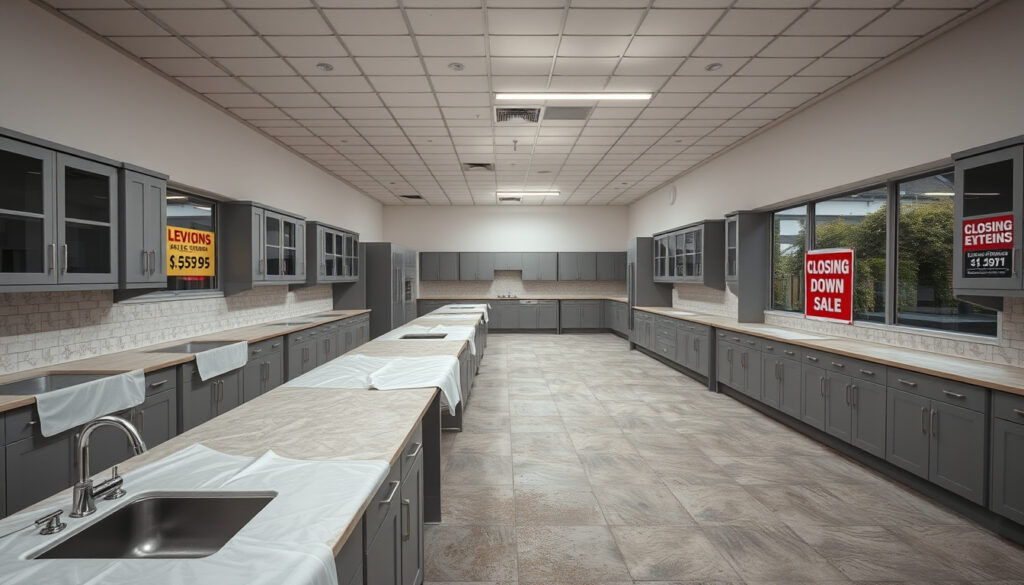
UK Largest Kitchen Supplier Administration: Waterline Bust
Waterline Limited collapsed into administration on 9 March 2024, ending more than seven decades as one of Britain’s largest wholesale distributors of kitchens and bathrooms to independent traders. The company’s demise left 105 workers facing redundancy and triggered an orderly wind-down of operations.
Jobs redundant: 105 · Administrators appointed: 9 October 2025 · Company trading since: over 70 years · Administrators: Alex Cadwallader and Dane O’Hara (Leonard Curtis)
Quick snapshot
- Waterline Limited entered administration on 9 March 2024 (Leonard Curtis)
- 105 jobs lost after appointment (Leonard Curtis)
- Assets to be realised through orderly wind-down (Leonard Curtis)
- Largest independent kitchen wholesaler in the UK (Interior Daily)
- Supplied traders for more than 70 years, founded 1947 (Leonard Curtis)
- Product range covered kitchens, bedrooms, and bathrooms (Leonard Curtis)
- Wren Kitchens holds the position of UK’s number one kitchen retailer (Interior Daily)
- Howdens dominates the trade kitchen supply segment (KBB Review)
- Waterline operated as a national distributor with depots across the country (Insolvency Insider)
- Asset realisation underway to repay creditors (Leonard Curtis)
- 15 staff retained temporarily to support wind-down (Leonard Curtis)
- No going-concern sale achieved; interest centred on stock and IP (Business Sale Report)
The table below consolidates the key facts surrounding Waterline Limited’s administration and financial performance.
| Detail | Value |
|---|---|
| Company | Waterline Limited |
| Status | Administration (wind down) |
| Date appointed | 9 October 2025 |
| Redundancies | 105 |
| Administrators | Alex Cadwallader, Dane O’Hara (Leonard Curtis) |
| Incorporated | 3 February 1947 |
| Turnover FY2024 | £44.3 million |
| Turnover FY2023 | £56.5 million |
| Gross profit FY2024 | £8.3 million |
| Operating result FY2024 | £2.2 million loss |
Who is the UK’s biggest kitchen supplier going bust?
Waterline Limited, one of the UK’s largest independent wholesale distributors in the kitchens, bedrooms, and bathrooms sector, entered administration on 9 March 2024 (Leonard Curtis). The company, incorporated on 3 February 1947, had operated for more than 70 years as a critical supply link for independent kitchen and bathroom traders across the country.
Waterline Limited overview
The company maintained national depots and served as a vital distribution channel for smaller retailers and installers who lacked the scale to deal directly with manufacturers. Waterline stocked products spanning multiple brands and formats, allowing independent traders to access a broad range without negotiating separate manufacturer agreements.
In its final financial year ending 31 March 2024, Waterline reported turnover of £44.3 million—a steep decline from £56.5 million the prior year (Business Sale Report). Gross profit fell from £11.8 million to £8.3 million over the same period, while the company posted an operating loss of £2.2 million compared to a profit of £390,000 in the previous year.
The numbers reveal a company under severe pressure: turnover dropped 21.6% year-on-year, gross profit contracted by nearly 30%, and Waterline swung from profit to a £2.2 million loss—all within a single financial year.
Role as wholesale distributor
Waterline occupied a distinct position in the market as a wholesaler serving independent traders rather than retail consumers. This model meant the company acted as an intermediary, aggregating products from multiple manufacturers and distributing them in quantities suited to smaller installers and boutique retailers.
The collapse leaves a gap in the supply chain for businesses that relied on Waterline’s breadth of product range and national delivery infrastructure. For these traders, finding alternative suppliers with comparable scale and variety may prove challenging in the near term.
The implication: this disruption arrives at a particularly difficult time for the sector, where cost pressures have already squeezed margins across the supply chain.
Which kitchen supplier has gone bust?
Waterline Limited is the kitchen supplier that entered administration. Joint Administrators Alex Cadwallader and Dane O’Hara from Leonard Curtis were appointed by the High Court on 9 October 2025 (Leonard Curtis). The appointment followed months of failed attempts to sell the business as a going concern.
Administration details
Leonard Curtis was formally instructed by Waterline Limited in March 2024 to assess its financial position and launched an accelerated M&A process (Leonard Curtis). Expressions of interest were received for Waterline’s assets—principally stock and intellectual property rights—but no party showed appetite for acquiring the business as a going concern.
“We are disappointed that a sale did not take place, despite reaching out to both industry and non-industry specific parties as part of our regulated process,” said Alex Cadwallader (Leonard Curtis). Axia VS acted as agents and Crowell & Moring served as solicitors during the administration process.
Redundancies announced
Following the appointment, 105 redundancies occurred at Waterline Limited, with 15 staff retained to support the ongoing wind-down (Leonard Curtis). The administrators have prepared a wind-down plan designed to realise asset value, assist Retention of Title suppliers, and benefit the company estate.
The administrators cannot fulfil or take any new orders for Waterline Limited, effectively ending the company’s trading operations (Leonard Curtis). Customers with outstanding orders should contact the administrators directly for guidance on their specific situation.
Independent traders previously reliant on Waterline should monitor announcements from the administrators regarding asset sales. Interest has been reported in Waterline’s stock and intellectual property, which could eventually become available through a buyer.
Who is the largest kitchen retailer in the UK?
Wren Kitchens holds the position of the UK’s number one kitchen retailer by market share and sales volume (Interior Daily). Unlike Waterline, which served trade customers exclusively, Wren operates directly with consumers through its network of showrooms.
Wren Kitchens claim
Wren Kitchens has invested heavily in manufacturing capacity and showroom expansion to cement its dominant position in the UK kitchen retail market. The company’s vertically integrated model—controlling production and distribution—gives it pricing power and supply chain efficiencies that smaller retailers struggle to match.
Market position
Wren’s dominance at the retail level contrasts sharply with Waterline’s position in the wholesale trade segment. While Waterline’s collapse will not directly affect Wren’s operations, it does underscore the broader pressures facing the kitchen and bathroom sector, where both retail and wholesale players have faced challenging trading conditions.
At the same time Wren Kitchens expands its retail footprint, Waterline—one of the sector’s largest wholesale infrastructure operators—has collapsed. The divergence highlights how different tiers of the market face distinct pressures: retail giants can leverage scale, while wholesalers like Waterline proved vulnerable to sector-wide headwinds.
The pattern: vertical integration appears to offer more resilience than the intermediary model that Waterline embodied.
Who is the UK’s number one trade kitchen supplier?
Howdens Holdco Limited, trading as Howdens Joinery, is widely recognised as the UK’s number one trade kitchen supplier (KBB Review). The company operates exclusively in the trade segment, supplying kitchens and joinery products to builders, installers, and tradespeople rather than retail consumers.
Howdens dominance
Howdens’ model centres on depot-based supply to tradespeople who need reliable access to kitchens and building materials for their projects. The company has expanded to hundreds of depots nationwide and maintains long-standing relationships with professional installers who value the consistency and availability the network provides.
Trade focus
Unlike Waterline, which aggregated products from multiple manufacturers, Howdens operates largely with its own manufactured ranges. This vertical approach insulates the company from some of the supplier relationship challenges that affected Waterline, though it faces its own competitive dynamics in the trade segment.
The catch: consolidation toward fewer suppliers may reduce negotiating leverage for smaller tradespeople who previously benefited from Waterline’s multi-brand offering.
Who is the best kitchen supplier in the UK?
Defining the “best” kitchen supplier depends heavily on context—whether the buyer is a large retailer, an independent trader, or a consumer. For trade customers, the question typically centres on range breadth, availability, and reliability rather than brand prestige alone.
Top brands listed
Several manufacturers consistently rank highly in trade and consumer assessments of kitchen quality, including established names in the sector. Rankings vary by publication and methodology, but brands with strong manufacturing credentials and warranty offerings tend to appear near the top of expert assessments.
Consumer vs trade perspectives
What constitutes the “best” supplier differs markedly between consumer and trade markets. Retail consumers often prioritise aesthetics, showroom experience, and consumer finance options, while trade buyers value product availability, delivery lead times, and pricing structures that accommodate project-based purchasing.
The implication: no single supplier serves all market segments optimally, which is why Waterline’s wholesale role mattered to the ecosystem.
Timeline
- — Waterline Limited incorporated (Leonard Curtis)
- — Exceptional growth period recorded (Leonard Curtis)
- — Decline begins as COVID restrictions lift and cost pressures mount (Business Sale Report)
- — Shareholder funding support becomes no longer viable (Leonard Curtis)
- — Leonard Curtis formally instructed; accelerated M&A process begins (Leonard Curtis)
- — Joint Administrators Alex Cadwallader and Dane O’Hara appointed by High Court (Leonard Curtis)
- — 105 redundancies confirmed; 15 staff retained for wind-down (Leonard Curtis)
What we know and what remains unclear
Confirmed facts
- Waterline Limited entered administration on 9 October 2025
- 105 redundancies occurred with 15 staff retained
- Joint Administrators: Alex Cadwallader and Dane O’Hara from Leonard Curtis
- Orderly wind-down and asset realisation underway
- No going-concern sale was achieved
- Interest received for stock and intellectual property assets
What’s unclear
- Exact identities of Waterline’s shareholders and amounts of funding provided
- Specific depot locations and regional impacts of the closure
- Estimated creditor claims and potential recovery rates from asset sales
- Whether any buyer has since emerged for Waterline’s stock or IP
- Details on individual supplier relationships and outstanding obligations
What the administrators said
“We are disappointed that a sale did not take place, despite reaching out to both industry and non-industry specific parties as part of our regulated process.”
— Alex Cadwallader, Joint Administrator, Leonard Curtis (Leonard Curtis announcement)
“A key driver for the board of Waterline was the safeguarding of jobs for employees with the aim of a going concern sale. However despite their best efforts, the external factors pressures in the economy and the sector specifically meant a buyer could not be found.”
— Dane O’Hara, Joint Administrator, Leonard Curtis (Interior Daily report)
Waterline’s board had prioritised finding a buyer as a route to protecting jobs, but broader economic conditions and sector-specific pressures proved insurmountable obstacles (Interior Daily). The collapse is linked to broader challenges affecting the kitchen and bathroom sector, including rising interest rates, the cost of living pressures reducing consumer spending on home improvements, and the unwinding of pandemic-era demand that had temporarily boosted the market.
What this means for the market
Waterline’s collapse is the most significant wholesale distribution failure in the UK kitchen and bathroom sector in recent years, leaving independent traders facing an immediate supply gap. The company’s 70-year history ended not with a dramatic scandal but with the grinding pressure of declining revenues, tightening funding, and a failed sale process. For independent kitchen traders who relied on Waterline’s breadth and national reach, the priority is clear: establish alternative supply relationships now, before existing stock buffers run dry. For the broader market, Waterline’s fate serves as a stark reminder that even well-established businesses can succumb to the combined weight of economic headwinds when the structural advantages that sustained them erode faster than they can adapt.
Related reading: cost-of-living crisis · cost of living payments
Waterline’s administration, after 70 years serving independents, echoes the recent CW Sellors collapse of Derbyshire jeweller CW Sellors, amid broader UK retail pressures.
Frequently asked questions
What caused Waterline’s administration?
Waterline experienced exceptional growth during 2021–2022 but faced mounting pressure once COVID restrictions lifted. Rising interest rates, the cost-of-living crisis reducing consumer spending on home improvements, and the withdrawal of shareholder funding support combined to make the business untenable. The board attempted a sale process but no going-concern buyer emerged.
Who takes over Waterline’s operations?
Alex Cadwallader and Dane O’Hara from Leonard Curtis were appointed as Joint Administrators on 9 October 2025. They are managing an orderly wind-down and asset realisation. The administrators are not trading the business—they are working to maximise returns for creditors from available assets.
Can Waterline customers still get support?
The administrators cannot fulfil or take new orders for Waterline Limited. Customers with outstanding orders should contact the administrators directly for guidance. The priority for affected customers is to source products from alternative suppliers as soon as possible.
How does this affect kitchen prices in UK?
Waterline’s closure removes one wholesale channel from the market, which could exert upward pressure on prices for independent traders who now face reduced sourcing options. However, the impact will vary depending on product ranges and whether alternative distributors can absorb the demand.
Is Crown Imperial affected?
Crown Imperial is a separate manufacturer and is not in administration. Reports suggesting otherwise appear to be misinformation. Waterline was a distributor supplying products from multiple manufacturers, not a direct subsidiary of Crown Imperial.
What are Waterline’s main kitchen brands?
Waterline distributed products across multiple brands in the kitchens, bedrooms, and bathrooms sector. Specific brand relationships were not detailed in the administrator’s announcement, but the company’s strength lay in its breadth of range from various manufacturers rather than exclusive brand partnerships.
Duchy Kitchens status post-Waterline?
Duchy Kitchens is a separate brand in the market. Waterline’s collapse does not directly affect Duchy Kitchens’ operations. Independent traders previously sourcing through Waterline who dealt in Duchy products will need to establish direct relationships with the manufacturer or find alternative wholesale channels.
More related posts
 Joy Crookes: Bengali-Irish Singer’s Music & Biography
 The Cabin in the Woods – Plot, Cast, Ending Explained
 Tijjani Reijnders: Ethnicity, Career, and Black Eye Story
 Pixie Geldof: Biography, Family, Marriage Rumors, and Latest News
 Oliver Stark: Partner, Birthmark, Name Change & Net Worth
 Kirk Douglas: Life, Career, Charitable Will, and Stroke Recovery
 Paige WWE: Why She Left, OnlyFans & Where She Is Now
 Charlie Mullins: From School Dropout to Multimillionaire