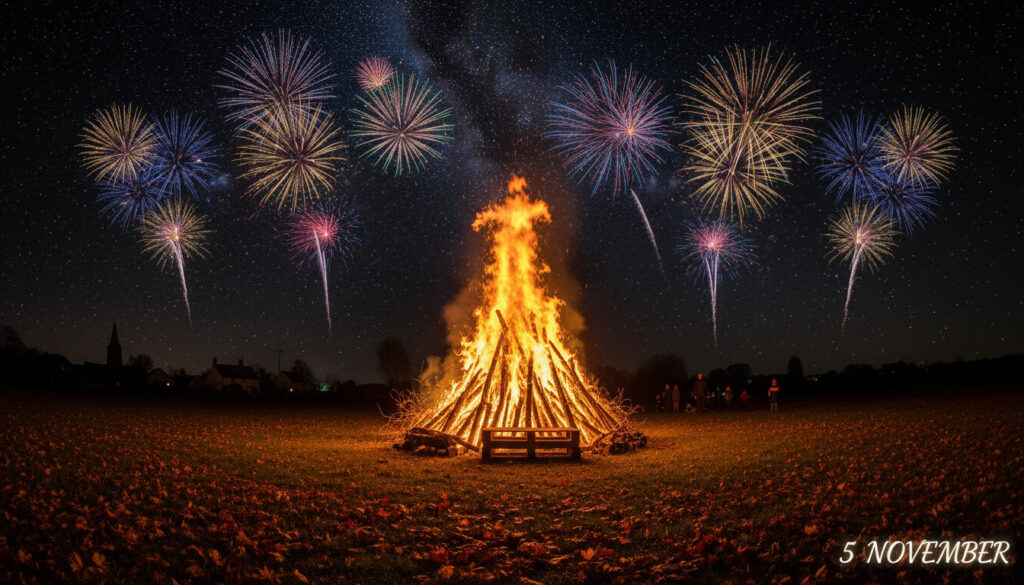
When Is Bonfire Night – 5 November 2025 on Wednesday
The Fixed Date of British Bonfire Night
Every year on 5 November, the United Kingdom illuminates with fireworks and bonfires to commemorate a failed assassination attempt that occurred over four centuries ago. Bonfire Night, also known as Guy Fawkes Night or Fireworks Night, marks the date in 1605 when authorities foiled the Gunpowder Plot against King James I. In 2025, this annual commemoration falls on a Wednesday, maintaining the fixed calendar position that has defined the celebration since its inception.
Key Facts at a Glance
| Date | 5 November (annual, fixed) |
|---|---|
| 2025 Commemoration | Wednesday, 5 November 2025 |
| Historical Origin | 1605 Gunpowder Plot |
| Alternative Names | Guy Fawkes Night, Fireworks Night |
| Established By | Observance of 5th November Act 1605 |
Why the Date Never Changes
The date remains immovable, etched into British tradition by parliamentary decree. Unlike religious festivals that follow lunar calendars or civic holidays that shift to create long weekends, Bonfire Night anchors itself to a specific historical moment. The Gunpowder Plot was discovered in the early hours of 5 November 1605, and the nation has marked that precise anniversary ever since.
James I’s government formalized the observance through the Observance of 5th November Act, passed in January 1606. This legislation mandated annual thanksgiving for the King’s delivery from assassination, establishing sermons and bell-ringing that evolved into the fireworks displays familiar today.
Upcoming Bonfire Night Dates
| Year | Date | Day of Week |
|---|---|---|
| 2025 | 5 November | Wednesday |
| 2026 | 5 November | Thursday |
| 2027 | 5 November | Friday |
| 2028 | 5 November | Sunday |
| 2029 | 5 November | Monday |
The Historical Context
The conspiracy emerged from intense religious polarization. Guy Fawkes and his co-conspirators—Robert Catesby, Thomas Percy, and others—intended to detonate 36 barrels of gunpowder beneath the House of Lords. Their goal: the assassination of Protestant King James I and the installation of his Catholic daughter, Princess Elizabeth, as a puppet monarch.
The plot collapsed when Lord Monteagle received an anonymous letter warning him to avoid Parliament on the opening day. Authorities conducted a cellar search on the evening of 4 November, discovering Fawkes guarding the explosives. His capture ensured the King’s survival and sealed the conspirators’ fates.
Timeline of the Conspiracy
The events unfolded across several years, culminating in the November discovery.
- 1603: James I ascends to the English throne, disappointing English Catholics who hoped for greater tolerance.
- 20 May 1604: Robert Catesby meets with Thomas Wintour and Jack Wright at the Duck and Drake inn to initiate the plot.
- 26 October 1605: William Parker, 4th Baron Monteagle, receives the anonymous warning letter at his Hoxton residence.
- 4 November 1605: John Johnson (Guy Fawkes’s alias) is discovered in the parliamentary cellars with matches and combustible materials.
- 5 November 1605: Londoners light bonfires to celebrate the King’s deliverance.
- 31 January 1606: Executions of Fawkes, Rokewood, Keyes, and Winter at St Paul’s Churchyard and Old Palace Yard.
Clarity on Timing
Confusion occasionally arises regarding the exact timing of celebrations. While the traditional date remains strictly 5 November, local councils and private organizers frequently schedule displays for the nearest weekend to maximize attendance and minimize school-night disruption. This practical flexibility does not alter the official anniversary date.
The distinction between the calendar date and the celebration date proves crucial for historians and tradition-keepers. Remembrance Day, by contrast, moves its primary observance to the closest Sunday, whereas Bonfire Night maintains its fixed position regardless of the weekday.
Contemporary Significance
Today, the 5th of November serves dual functions. It operates as a historical anchor, reminding citizens of a time when political violence threatened the state apparatus. Simultaneously, it functions as an autumnal festival, marking the descent into winter with pyrotechnics and communal gatherings.
The commercial fireworks industry depends significantly on this single date, with retail sales concentrating in late October and early November. Environmental concerns and safety regulations have gradually shaped modern celebrations, though the fundamental attraction of open fires and explosive displays persists.
By the nineteenth century, Victorian reformers had transformed the celebration into a community-focused event, emphasizing fireworks and charitable giving over religious intolerance. This evolution allowed the tradition to survive into modern, multicultural Britain.
Historical Voices
“Remember, remember, the Fifth of November, the Gunpowder Treason and Plot.”
— Traditional English verse
“Their intention was to blow up the King and the whole company of the Lords and Commons.”
— King James I, address to Parliament, 9 November 1605
Summary
Bonfire Night occupies a singular position in British culture as a fixed anniversary of national deliverance. Whether falling on a quiet Tuesday or a festive Saturday, the 5th of November maintains its historical integrity. For 2025, this means midweek celebrations on Wednesday, 5 November, continuing an unbroken tradition of over four centuries.
Frequently Asked Questions
Is Bonfire Night always celebrated on 5 November?
Yes, the official date remains fixed on 5 November each year. While community events may shift to nearby weekends for practical reasons, the anniversary itself commemorates the specific date of the Gunpowder Plot’s discovery in 1605.
What day of the week is Bonfire Night 2025?
In 2025, Bonfire Night falls on Wednesday, 5 November.
Why does the UK celebrate Bonfire Night?
The celebration marks the failure of the Gunpowder Plot in 1605, when authorities discovered explosives beneath the House of Parliament, saving King James I from assassination.
Is Guy Fawkes Night the same as Bonfire Night?
Yes, these terms are interchangeable. Guy Fawkes Night refers to the most famous conspirator, while Bonfire Night describes the traditional method of celebration.
Do fireworks displays always happen on the 5th?
Not necessarily. While traditionalists observe the exact date, many public displays occur on the nearest Friday or Saturday to accommodate larger crowds and avoid school nights.
Is Bonfire Night celebrated outside the UK?
The tradition remains strongest in Great Britain, though former British colonies and Commonwealth nations occasionally hold similar celebrations. The specific historical context, however, remains uniquely British.
More related posts
 50th Wedding Anniversary Gifts: Traditional Gold Ideas & More
 Lisa Marie Presley: Cause of Death, Children, and Legacy
 Ring of Power Sea on 3: Relea e Date, Ca t, and New
 Wayans Brothers: Who’s the Most Famous, Oldest, and Which One Died
 Aubrey Plaza: Husband’s Death, Stroke, and Baby News
 Irrfan Khan Cause of Death, Biography, Net Worth & Legacy
 Matthew Goodwin: Biography, Politics, and Controversy
 Iran Supreme Leader: Who Succeeds Khamenei