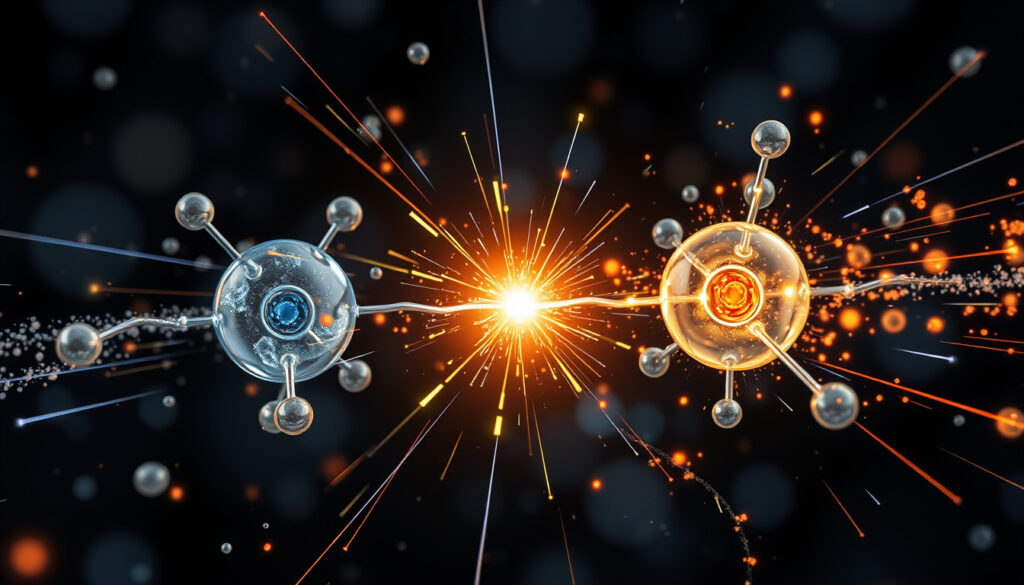
What Is an Ion? Simple Definition, Examples & Formation
Charged particles called ions explain everything from why table salt dissolves in water to how your phone battery powers your device. Understanding ions unlocks everyday science—from kitchen chemistry to nerve function—with clear definitions and real examples for curious kids through GCSE chemistry students.
Basic Definition: Atom or molecule with net electric charge · Charge Origin: Gain or loss of electrons · Common Examples: Na⁺ (sodium ion), Cl⁻ (chloride ion) · Key Contexts: Chemistry, biology, physics
Quick snapshot
- An ion carries a net electrical charge because it has unequal numbers of protons and electrons (Wikipedia)
- Cations form when atoms lose electrons; anions form when atoms gain electrons (Chemicals.co.uk)
- Metals produce cations; non-metals produce anions (Save My Exams Edexcel)
- Precise ion behaviour in specific biological cell types varies with experimental conditions (Seneca Learning)
- Exact energy thresholds for ionisation in Groups 3–5 elements depend on environmental factors (Cognito)
- Michael Faraday coined the term “ion” in 1834, from the Greek word for “traveller” (Wikipedia)
- UK GCSE curricula standardised ions in atomic structure topics circa 1988 (Seneca Learning)
- Ions remain central to battery technology research and medical ion therapy developments (Chemicals.co.uk)
- Understanding ions prepares students for A-level chemistry and careers in materials science (Save My Exams)
| Label | Value |
|---|---|
| Definition | Charged atom or molecule |
| Protons vs Electrons | Unequal numbers |
| Positive Ion | Cation (lost electrons) |
| Negative Ion | Anion (gained electrons) |
| Real-World Use | Batteries, medicine |
| Educational Context | GCSE Chemistry |
What is a simple definition of ion?
The most straightforward answer is this: an ion is an atom or molecule that carries an electric charge because it has either lost or gained one or more electrons. Unlike a normal atom with equal numbers of protons (positive) and electrons (negative), an ion has an imbalance—and that imbalance gives it a net charge.
Khan Academy defines it concisely as “an atom with electric charge,” emphasising that the charge arises specifically from unequal electron counts. Wikipedia adds that ions can be either atoms or complete molecules, which matters when we look at polyatomic ions like sulphate or hydroxide.
Core characteristics
- An ion always has a net electrical charge—either positive or negative
- The charge magnitude equals the number of electrons lost or gained
- The number of protons stays fixed during ion formation; only electrons change
- Ions are distinct from neutral atoms, which have equal positive and negative charges
Charge types
Two terms cover all possible ion charges. Cations carry a positive charge because the atom lost electrons, leaving more protons than electrons. Anions carry a negative charge because the atom gained extra electrons. The distinction matters enormously in chemistry—it’s the foundation for ionic bonding between opposite charges.
Sodium ion (Na⁺) has 11 protons but only 10 electrons—giving it a +1 charge. Chloride ion (Cl⁻) has 17 protons and 18 electrons—giving it a −1 charge. The pattern holds for every ion: count the difference between protons and electrons to find the charge.
How to explain an ion to a kid?
Kids encounter the concept best through vivid, physical analogies. An atom is like a tiny solar system with a nucleus (sun) at the centre and electrons (planets) orbiting around it. Normally, the number of planets equals the number of suns in terms of charge, keeping everything balanced and neutral.
An ion forms when one of those planets either escapes or gets added. If an electron flies off, there’s one less negative charge—so the whole thing becomes slightly positive. If an extra electron gets caught, there’s one extra negative charge—so the whole thing becomes slightly negative. Kids can picture this as a game of plus-and-minus charges that always need to balance out.
Everyday analogies
- Think of ions like imbalanced scales: when one side has more weight, it tips positive or negative
- Balloons rubbed on hair create static electricity—electrons transfer from hair to balloon, making the balloon negatively charged (like an anion)
- Magnets attract or repel each other, similar to how opposite ion charges attract
Visual examples
Many science kits for children include simple experiments showing ion formation. A balloon stuck to the ceiling after rubbing it on a woolly jumper demonstrates negative charging in action. Salt crystals dissolving in water show ions separating and spreading through liquid—visible if you add a little food colouring. These hands-on experiences cement the abstract concept.
Children who grasp the “electron transfer” concept early build a strong foundation for understanding electricity, chemical reactions, and how batteries work. The everyday relevance keeps them engaged rather than treating ions as abstract textbook material.
What is an ion in chemistry?
In chemistry, ions are the charged particles that drive some of the most fundamental reactions. The process begins with ionisation—atoms gaining or losing electrons to achieve more stable configurations. In most cases, atoms form ions to complete their outer electron shells, reaching a stable state with eight electrons (or two for hydrogen and helium).
Save My Exams explains that GCSE chemistry frames ions as “electrically charged atoms formed by the loss or gain of electrons.” This definition anchors the concept in atomic structure, making it clear that electrons—the negatively charged particles—are the key players in ion formation.
Formation process
The chemistry becomes clear when we examine specific elements. Sodium (Na), atomic number 11, has electron configuration 2, 8, 1. It sits just one electron short of a complete outer shell. Losing that single outer electron gives sodium a stable configuration (2, 8) and a +1 charge as Na⁺. Chlorine (Cl), atomic number 17, has configuration 2, 8, 7. It needs one electron to complete its shell, so it gains an electron to become Cl⁻ with configuration 2, 8, 8.
Electronegativity determines whether an atom donates or accepts electrons during ion formation. Metals (low electronegativity) readily lose electrons; non-metals (high electronegativity) readily gain them. Chemicals.co.uk confirms this pattern shapes which ions different elements form.
Ionic compounds
When cations and anions meet, they form ionic compounds through electrostatic attraction. Sodium ions (Na⁺) and chloride ions (Cl⁻) combine to form sodium chloride—ordinary table salt. The ionic bond between them holds the crystal lattice together. This is why ionic compounds typically have high melting points and conduct electricity when dissolved in water: the ions become mobile.
Group 1 elements (lithium, sodium, potassium) lose 1 electron to form 1+ ions. Group 2 elements (beryllium, magnesium, calcium) lose 2 electrons to form 2+ ions. Group 7 elements (fluorine, chlorine, bromine) gain 1 electron to form 1− ions. The periodic table literally predicts ion charges.
The catch: atoms in Groups 3–5 rarely form ions because losing or gaining the required electrons demands too much energy. Their electron configurations are inherently more stable without ionisation, which is why you rarely encounter ions from elements like carbon or nitrogen in basic chemistry.
“An ion is an atom that has an electric charge because it’s either lost or gained one or more of its electrons.”
— Chemicals.co.uk (Science Blog)
“An ion is a charged particle formed when an atom gains or loses electrons.”
— Khan Academy (Free Education Platform)
“In GCSE chemistry, an ion is an electrically charged atom which is formed by the loss or gain of electrons.”
— Save My Exams (GCSE Revision Resource)
How is an ion formed?
Ion formation happens through electron transfer—when one atom gives up electrons and another accepts them. The mechanism varies depending on context, but the core process always involves electrons moving between atoms, changing the balance between positive protons and negative electrons.
In ionic bonding, metals typically lose electrons to nearby non-metals. In aqueous solutions, ionisation occurs when dissolved substances separate into their constituent ions. Under ionising radiation, atoms can lose electrons independently, forming ions even in gases. Wikipedia notes that ions exist in solutions or independently under conditions like ionising radiation.
Electron transfer
Electron transfer happens because atoms seek stable electron configurations—typically a full outer shell. Group 1 metals have one electron in their outer shell; shedding it leaves a complete shell behind. Group 7 non-metals have seven outer electrons; gaining one fills the shell. This drive for stability is the fundamental engine of ion formation.
Ionisation methods
- Collision ionisation: Energetic particle collisions strip electrons from atoms (common in gases)
- Photoionisation: High-energy light photons eject electrons from atoms
- Thermal ionisation: Extreme heat provides enough energy for electron loss
- Chemical ionisation: Electron transfer during redox reactions in solutions
Ionisation always requires energy input—whether from heat, light, or chemical reactions. The energy needed increases for elements with higher ionisation energies (Groups 3–5 elements). This energy cost is why not all atoms ionise readily and why ion formation is a selective process.
Why this matters: the energy requirements for ionisation explain why certain elements form ions more readily than others. For GCSE students, recognising this pattern—metals lose, non-metals gain—answers most exam questions about ion formation.
What is an ion example?
Concrete examples make the concept tangible. The most commonly cited pair is sodium ion (Na⁺) and chloride ion (Cl⁻)—the components of table salt. Na⁺ forms when sodium atoms lose one electron; Cl⁻ forms when chlorine atoms gain one electron. Together, they create sodium chloride crystals through ionic bonding.
Hydroxide ion (OH⁻) and sulphate ion (SO₄²⁻) demonstrate polyatomic ions—groups of atoms that move together as a single charged unit. Wikipedia provides these examples alongside the monatomic ions, showing that ion chemistry extends well beyond single-atom particles.
Common ions
| Ion | Symbol | Type | Formed From |
|---|---|---|---|
| Sodium ion | Na⁺ | Monatomic cation | Na loses 1 electron |
| Chloride ion | Cl⁻ | Monatomic anion | Cl gains 1 electron |
| Potassium ion | K⁺ | Monatomic cation | K loses 1 electron |
| Hydrogen ion | H⁺ | Monatomic cation | H loses 1 electron (single proton) |
| Hydroxide ion | OH⁻ | Polyatomic anion | O + H gain 1 electron |
| Sulphate ion | SO₄²⁻ | Polyatomic anion | S + 4 O gain 2 electrons |
This table shows how the periodic table position predicts ion charge. Group 1 metals always lose the same number of electrons; Group 7 non-metals always gain the same number.
In biology and physics
Biology relies heavily on ion behaviour. Nerve impulses travel along neurons through the movement of sodium ions (Na⁺) and potassium ions (K⁺) across cell membranes. Calcium ions (Ca²⁺) trigger muscle contractions and serve as signalling molecules. Seneca Learning notes that ions play crucial roles in these biological processes at the GCSE level.
Physics encounters ions in plasma states, ion propulsion engines for spacecraft, and particle accelerators. Charged particle physics depends on ions for beam experiments. Battery technology centres on ion movement between electrodes—lithium ions (Li⁺) in lithium-ion batteries reversibly shuttle between electrodes during charge and discharge cycles.
The hydrogen ion (H⁺) is technically just a single proton—hydrogen loses its sole electron entirely. Yet this simplest of all ions is one of the most biologically significant, controlling pH balance in blood and powering hydrogen fuel cells.
“An ion (/ˈaɪ.ɒn, -ən/) is an atom or molecule with a net electrical charge.”
— Wikipedia (Encyclopedia Entry)
Upsides
- Systematic predictability: periodic table position determines ion charge
- Explains real-world chemistry: salt formation, battery operation, nerve function
- Clear examples available across chemistry, biology, and physics
- Builds foundation for understanding acids, bases, and electrolytes
Downsides
- Groups 3–5 elements rarely form ions, requiring different bonding explanations
- Polyatomic ions must be memorised as individual cases
- Ion formation requires energy, limiting spontaneity in some reactions
- GCSE-level explanations may oversimplify plasma and high-energy states
Related reading: apple cider vinegar benefits · red wine health effects
Chemistry basics like atomic structure lead naturally into simple ion definition and examples, highlighting formation processes with kid-friendly illustrations.
Frequently asked questions
What is an ion in biology?
In biology, ions are essential for nerve impulse transmission, muscle contraction, and maintaining pH balance in bodily fluids. Sodium ions (Na⁺), potassium ions (K⁺), and calcium ions (Ca²⁺) regulate cellular processes and enable communication between neurons.
What is an ion vs molecule?
A molecule consists of two or more atoms bonded together with no net charge. An ion, by contrast, carries a net electrical charge—either positive or negative—because it has unequal numbers of protons and electrons. Some ions (polyatomic ions) are molecules, but not all molecules are ions.
What is an ion in physics?
In physics, ions are charged particles studied in contexts like plasma physics, particle accelerators, and ion propulsion systems. Their charge-to-mass ratio affects how they behave in electric and magnetic fields, making them essential for technologies like mass spectrometers.
What is an ion atom?
An ion atom refers to an atom that has become an ion by gaining or losing electrons. The term emphasises that the ion originated from an atom—the core nucleus with its protons remains unchanged; only the electron count differs.
What is an ion vs isotope?
An isotope is a variant of an element with the same number of protons but a different number of neutrons—all isotopes of an element remain electrically neutral. An ion has a different number of electrons than protons, giving it a net charge. Isotopes and ions are independent properties: an isotope can exist as an ion or a neutral atom.
What is a simple ion?
A simple ion (monatomic ion) is a single atom with a charge—either positive or negative. Examples include Na⁺, Cl⁻, K⁺, and H⁺. This contrasts with polyatomic ions like OH⁻ or SO₄²⁻, which contain multiple atoms bonded together.
What is an ion GCSE?
In GCSE chemistry, ions are defined as “electrically charged atoms formed by the loss or gain of electrons.” The curriculum covers how atoms achieve stable electron configurations, the difference between cations and anions, ionic bonding between opposite charges, and how ion charges relate to periodic table groups.
For chemistry students, the path forward is clear: master the connection between electron configuration and ion formation, memorise the common ion charges by group, and practise writing ionic equations. These skills form the backbone of A-level chemistry and beyond.
More related posts
 Julia Bradbury: Health, Career, Teetotal Lifestyle
 Kilimanjaro Mountain: Height, Safety & Everest Comparison
 O2 Arena Seating Plan – Best Seats and Layout Guide
 Wayne Mardle: Wife’s Death, New Girlfriend, Career & More
 Aubrey Plaza: Husband’s Death, Stroke, and Baby News
 Bre Tiesi: Age, Kids, Relationship With Nick Cannon & Career
 Arsenal vs Crystal Palace – Match Preview, Prediction, Team News